Scrap car removal gives you instant cash, frees up property space, and keeps hazardous materials out of Ontario’s soil and waterways. These benefits of scrap car removal apply whether your vehicle runs or not. Certified removal services across the Greater Toronto Area (GTA) handle the entire process, from towing to paperwork, so you spend zero time at a scrapyard.
In 2026, automotive recycling in Canada processes over 1.6 million end-of-life vehicles (ELVs) each year. Every ELV removed by a licensed company prevents an average of 4.5 gallons (17 litres) of toxic fluids from seeping into the ground. The steps below show exactly what you gain.
How You Get Paid Instantly for a Junk Car
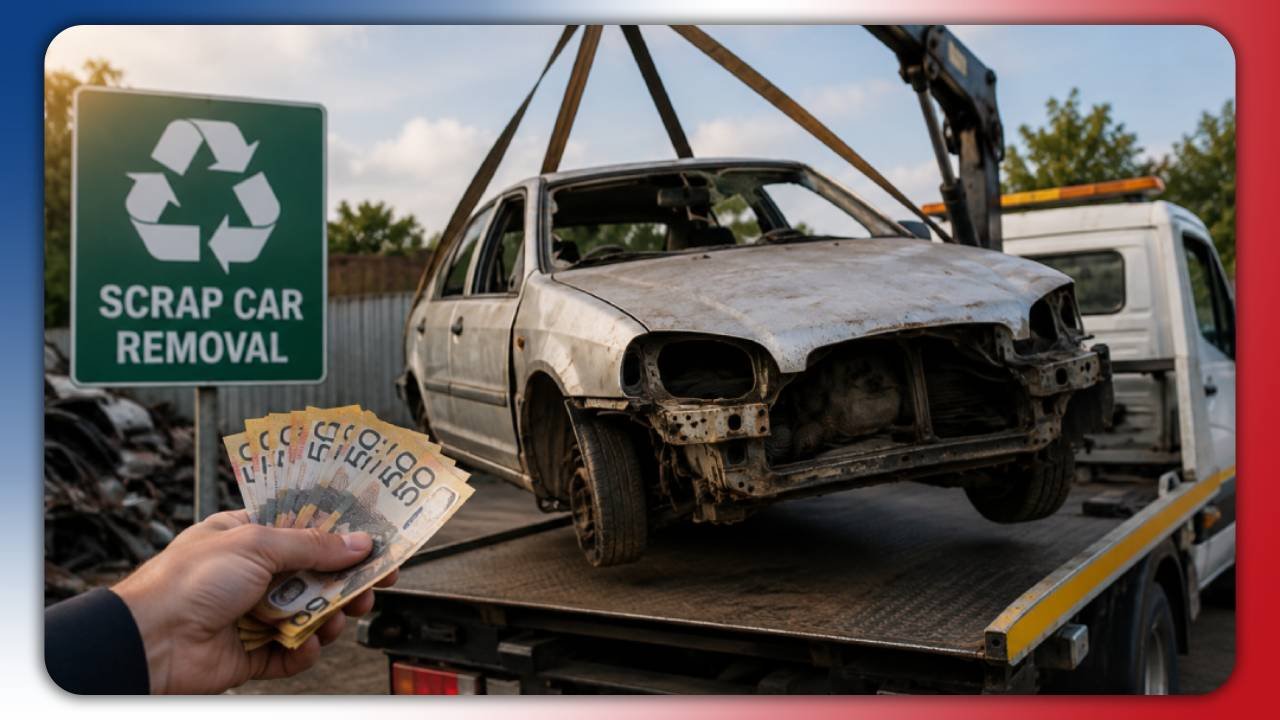
Scrap car removal pays you on the day of pickup. You do not negotiate with private buyers, wait for bank transfers, or pay listing fees. A certified buyer assesses your vehicle’s make, model, year, condition, and the current scrap steel price: then makes a firm offer before arriving.
How Much Money You Can Expect for a Scrap Car
To calculate a scrap car payout, multiply the vehicle’s curb weight by the current scrap steel rate. A 2005 Honda Civic weighs roughly 2,700 lb (1,225 kg). At a steel rate of $0.07 per pound (CAD), the base metal value is approximately $189. Licensed buyers often pay above the raw metal rate because they recover higher-value parts first, including the catalytic converter, alternator, and transmission.
Catalytic converters alone fetch $50 to $300 depending on the platinum, palladium, or rhodium content. You receive one lump-sum cash payment at pickup: no deductions, no towing fees, no hidden charges from reputable companies.
You can book a junk car pickup service with ScrapCars4Cash and receive a firm quote before the truck arrives. The company serves the GTA, Durham Region, and surrounding communities.
Benefits of Scrap Car Removal for the Environment
A vehicle left sitting for 2 or more years leaks motor oil, coolant, brake fluid, and battery acid. These fluids contaminate soil within a 10-foot (3-metre) radius and reach groundwater within 18 months in sandy or loam soil types. Professional removal eliminates these hazards before they spread.
What Happens to a Scrapped Car at a Recycling Facility
To recycle an end-of-life vehicle, the dismantler follows a 5-step process:
- Drain all fluids: oil, coolant, brake fluid, and refrigerant: through certified channels.
- Remove high-value parts: engines, transmissions, body panels, and catalytic converters: for resale.
- Shred the remaining steel body shell at a metal recycling facility.
- Sort recovered materials: steel, aluminum, copper, and platinum: by type.
- Send auto shredder residue (ASR) to licensed waste processors for final treatment.
Up to 80% of a car by weight is recyclable through this process. AI-powered dismantling systems, deployed at major Canadian recycling yards since 2024, recover close to 90% of a vehicle’s weight. Recycled steel requires 74% less energy to produce than virgin steel from iron ore, which directly reduces greenhouse gas (GHG) emissions per tonne manufactured.
How Removing a Scrap Car Protects Local Soil and Water
To protect your property and the surrounding environment, remove the vehicle before corrosion breaks the fuel tank or brake lines. A single vehicle can release up to 1 quart (0.95 litres) of motor oil into soil before visible staining appears. Oil-saturated soil loses its load-bearing capacity and may require remediation at $80 to $200 per cubic yard.
Lead-acid batteries contain sulfuric acid and 18 to 21 lb (8 to 9.5 kg) of lead per unit. A cracked battery case releases both into the immediate area. Certified dismantlers neutralize acid and recover lead for reuse in new batteries, keeping these materials out of landfills and surface water.
Benefits of Scrap Car Removal for Your Property and Safety
A non-operational vehicle takes up 160 to 180 square feet (14.9 to 16.7 square metres) of driveway or garage space. Removing it gives you space for a second vehicle, a workshop, or a landscaped area. Beyond space, an aging car creates 3 direct safety hazards:
- Sharp rust edges on body panels cut skin and puncture tires on adjacent vehicles.
- Collapsed suspension parts create tripping hazards 2 to 6 inches (5 to 15 cm) above ground.
- Rodents and insects nest in upholstery and wiring, then move into adjacent structures.
Ontario municipalities, including Toronto, Brampton, and Mississauga, classify inoperable vehicles left on private property for more than 72 hours as by-law violations. Fines range from $200 to $2,000 per occurrence, depending on the municipality.
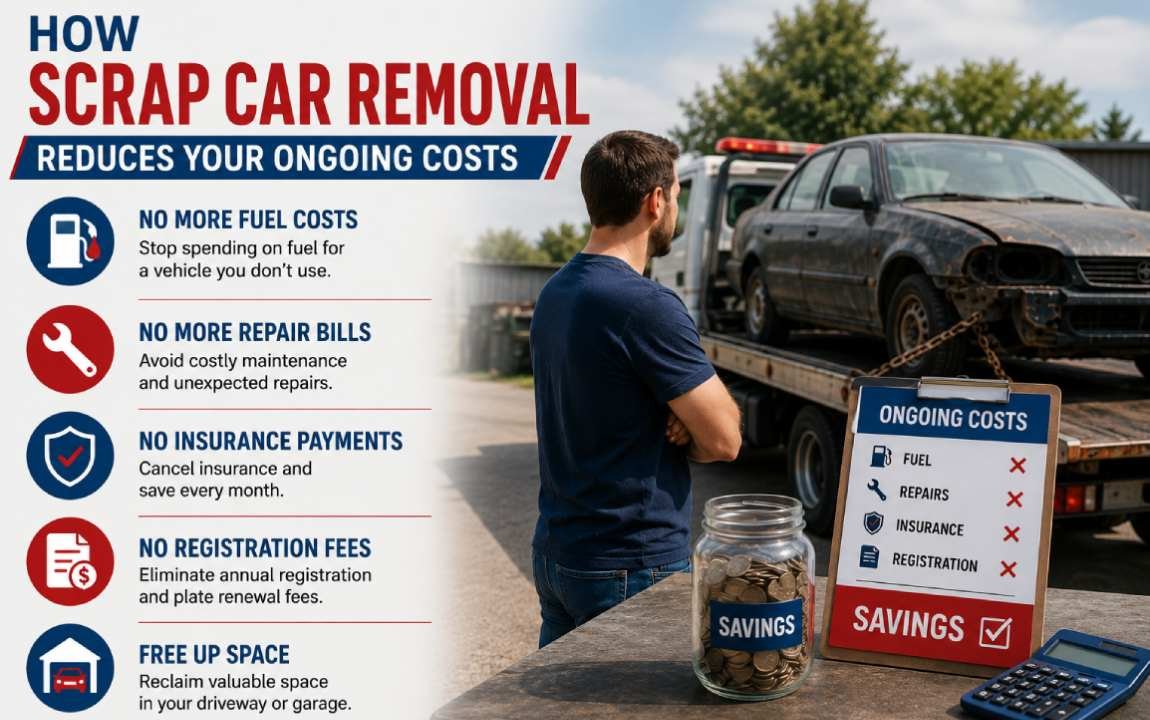
How Scrap Car Removal Reduces Your Ongoing Costs
Keeping a non-running vehicle on your property costs money even when the car does not move. You pay for insurance coverage on a vehicle you do not drive. Ontario requires at minimum liability coverage on a registered vehicle. Canceling the policy saves $80 to $350 per year depending on your insurer and coverage level.
Storage costs apply if the car sits in a rented lot. Commercial lots in the GTA charge $75 to $200 per month for an uncovered vehicle space. Removing the car immediately stops these charges.
Repair costs compound on aging vehicles. A 2008 or older vehicle facing engine or transmission failure costs $1,500 to $4,500 to repair: often more than the vehicle’s current resale value. Scrapping it guarantees a cash return rather than an uncertain repair investment.
Owners of vehicles damaged by accidents or floods also qualify for same-day removal. Review the accidental scrap cars page to see how insurance write-offs are handled and what documentation you need to bring.
How the Scrap Car Removal Process Works in Ontario
Ontario’s scrap car removal process is regulated by the Ministry of Transportation (MTO) and the Automotive Recyclers Association of Canada (ARAC). Here is the exact sequence:
- Request a quote: provide the year, make, model, and postal code online or by phone.
- Receive a firm offer: the buyer confirms the price before dispatch.
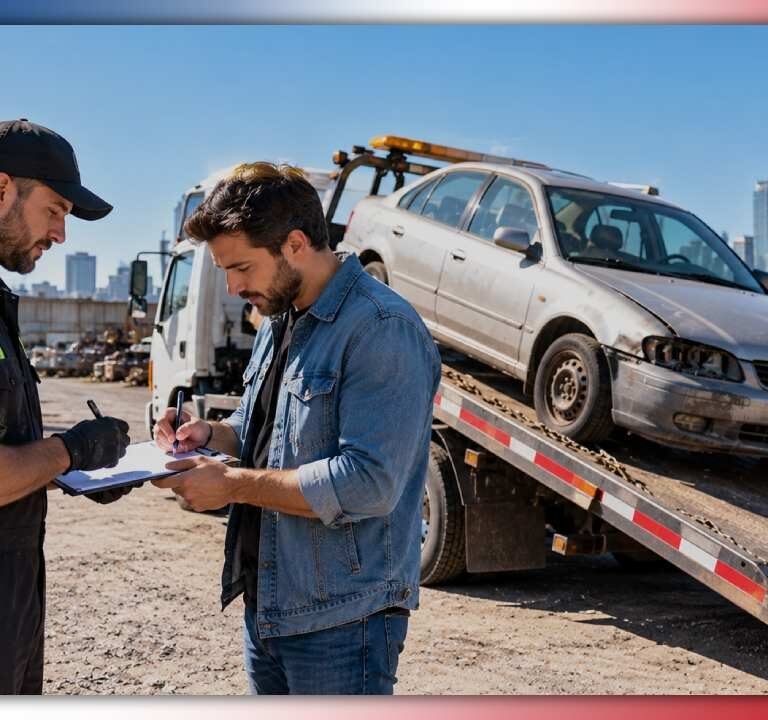
- Schedule a free tow: most GTA companies offer same-day or next-day pickup.
- Sign the vehicle title: transfer ownership at the time of pickup.
- Collect your cash payment: receive payment by cash or e-transfer on the spot.
- Cancel your plates: return license plates to a ServiceOntario location and apply for a refund on unused registration.
You do not need a safety certificate or emissions test to scrap a vehicle in Ontario. The buyer handles deregistration paperwork with the MTO. Keep a copy of the signed title transfer for your records.
Quick-Reference Guide: Scrap Car Removal Steps, Timing, and Difficulty
| Task | Timing | Method | Difficulty |
| Call for a quote | Same day | Phone or online form | Easy |
| Schedule pickup | Within 24–48 hours | Confirm address and time | Easy |
| Sign over the title | At pickup | Sign vehicle title to company | Easy |
| Receive cash payment | At pickup | Cash or e-transfer | Easy |
| Remove personal items | Before pickup | Check glove box, trunk, seats | Easy |
| Cancel insurance & plates | Same day as pickup | Contact insurer and MTO | Moderate |
| Confirm deregistration | Within 1–2 days | Request written confirmation | Easy |
How Scrap Car Removal Benefits Communities Across the GTA
Licensed scrap removal companies create local jobs in towing, dismantling, and parts resale. Each vehicle processed supports an average of 3 to 5 trade jobs across the supply chain. Recovered scrap steel feeds Ontario’s steel mini-mills, which produced 4.2 million tonnes of recycled steel in 2024 alone.
Parts recovered from scrapped vehicles, including headlights, doors, and steering columns, re-enter the used auto parts market at 40 to 70 percent below new OEM pricing. This gives other Ontario drivers access to affordable replacement parts, keeping older vehicles on the road longer and reducing total new-vehicle manufacturing demand.
Communities with high concentrations of abandoned vehicles see 23% lower property values within a 500-foot (152-metre) radius, based on Canadian municipal studies. Prompt removal through services like cash for cars Ontario directly supports neighbourhood property values.
What Types of Vehicles Qualify for Scrap Car Removal
Scrap car removal services accept 7 main vehicle categories:
- Sedans and coupes: including Toyota Corolla, Honda Civic, and Chevrolet Malibu models.
- SUVs and crossovers: including Ford Explorer, Jeep Grand Cherokee, and Nissan Rogue models.
- Pickup trucks: including Ford F-150, GMC Sierra, and Ram 1500 models.
- Minivans: including Chrysler Pacifica and Dodge Grand Caravan models.
- Commercial vans: including Ford Transit, Mercedes Sprinter, and Ram ProMaster models.
- Flood or fire-damaged vehicles: accepted regardless of the extent of damage.
- Vehicles without engines or transmissions: bought for scrap metal value alone.
The vehicle does not need to run, pass a safety inspection, or have all four tires inflated. The buyer’s flatbed or wheel-lift tow truck handles non-runners without extra charges.
Frequently Asked Questions About the Benefits of Scrap Car Removal
Does scrap car removal cost anything?
No. Reputable scrap car removal companies provide free towing as part of the service. You pay nothing out of pocket. The company recovers its costs from the scrap metal and resalable parts.
Can you scrap a car without the title in Ontario?
No. Ontario law requires you to sign over the vehicle title at the time of transfer. Without a title, the company cannot legally deregister the vehicle. Contact ServiceOntario to obtain a replacement title before booking pickup if yours is lost.
How long does a scrap car removal take from start to finish?
The entire process takes 24 to 48 hours from your initial call to cash in hand. Same-day service is available from most GTA providers when you call before noon.
Is it better to scrap a car or sell it privately?
Scrapping delivers faster payment with less effort for non-running vehicles. Private sales require a safety certificate, test drives, and negotiation. A car that runs but needs $1,200 or more in repairs typically returns more money through scrapping than a discounted private sale.
Does scrap car removal help the environment in 2026?
Yes. Automotive recycling in 2026 recovers up to 80% of a vehicle’s weight through steel, aluminum, copper, and platinum extraction. Recycled steel production emits 74% less carbon dioxide (CO2) than virgin steel production. Every scrapped vehicle prevents multiple gallons of hazardous fluid from entering Ontario’s groundwater.
Start the Process and Collect Your Cash Today
The benefits of scrap car removal in 2026 cover every priority: financial return, environmental protection, safety, space recovery, and regulatory compliance. You receive cash on pickup day, avoid ongoing insurance and storage costs, and prevent your property from becoming an environmental liability. Ontario’s licensed dismantlers handle the title transfer, deregistration, and towing so you take no additional steps beyond signing the document.
ScrapCars4Cash serves the full GTA and Durham Region with free same-day towing and competitive offers. Visit scrapcars4cash.ca to get your free quote and book a pickup: the truck can be at your door within hours.