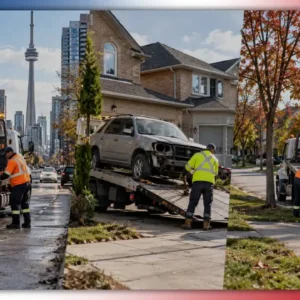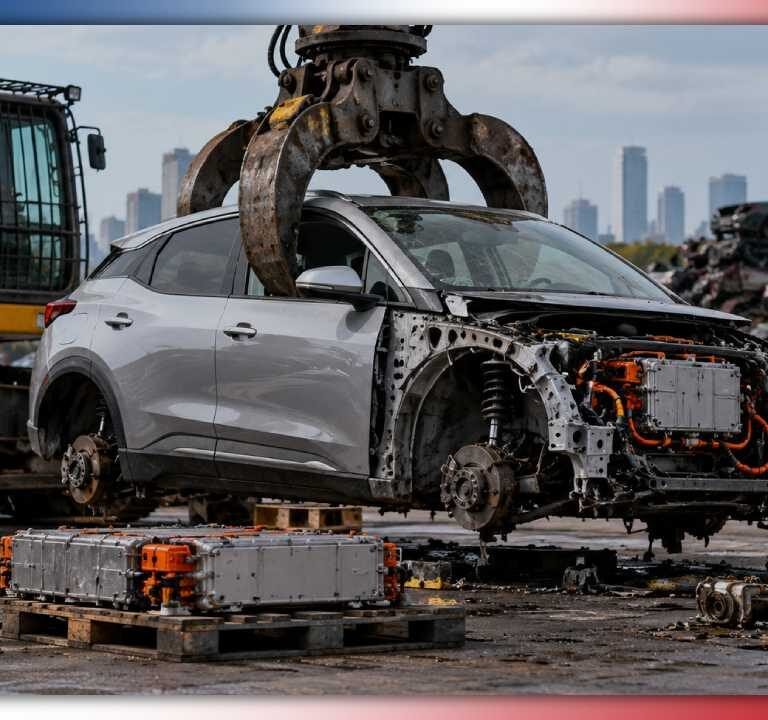
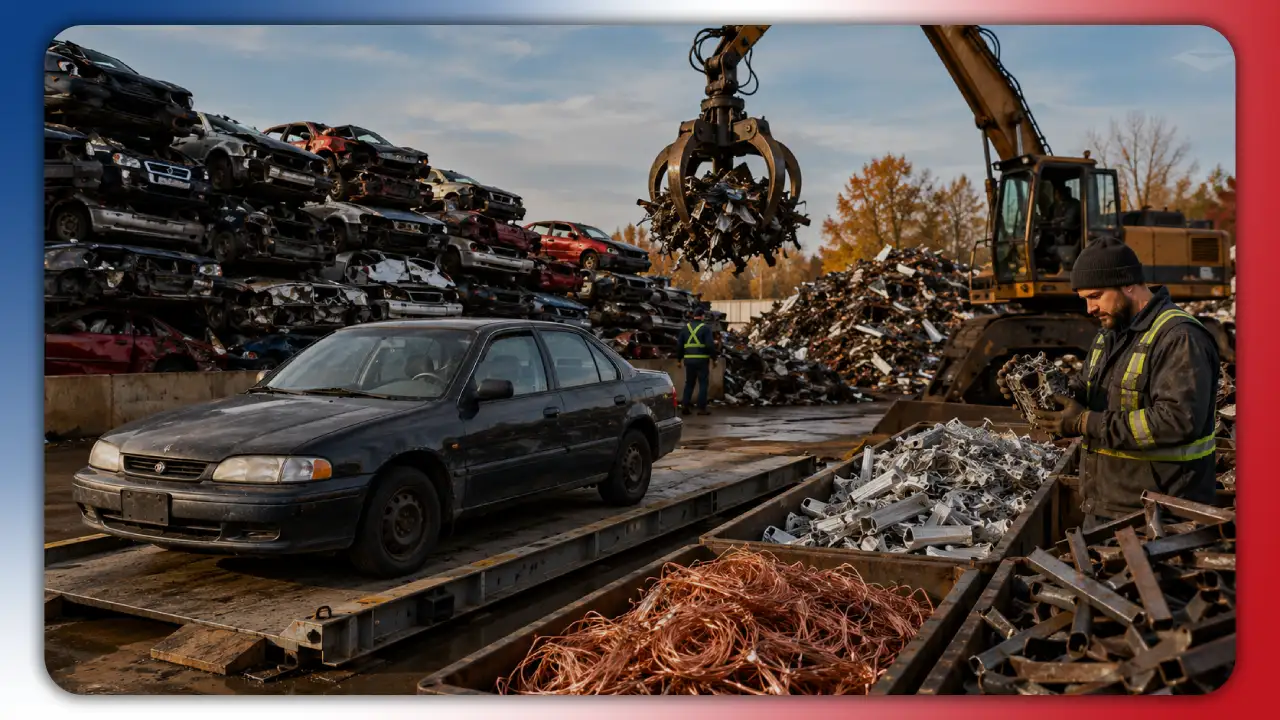
Scrap car prices in Ontario fluctuate with the steel, aluminum, and copper markets. There is no fixed rate card. Ontario sedans currently pay $250 to $600, and trucks pay $400 to $1,200. Both ranges shift as metal markets swing.
You get paid for your vehicle’s weight in metal. That weight gets multiplied by whatever a recycler can resell the metal for that week. When steel, copper, or catalytic converter metals rise, your quote rises with them. When those commodities drop, recyclers lower offers within days, not months.
This guide breaks the metal-price connection into four separate forces. Those forces are raw steel rates, the Canadian dollar, catalytic converter metals, and vehicle weight class. Each force moves your final number differently. You can check each one in minutes before you call a buyer.
What Are Today’s Scrap Car Prices in Ontario?
Ontario scrap car prices range from $250 to $1,200, depending on the vehicle’s class and weight. Sedans such as the Honda Civic, Toyota Corolla, and Hyundai Elantra typically bring $250 to $600. SUVs and trucks such as the Ford F-150, Honda CR-V, and Ram 1500 typically bring $400 to $1,200.
Three factors set your specific number. Those factors are vehicle weight, the current Ontario steel rate per pound, and catalytic converter status. A missing catalytic converter can cut your offer by $100 to $500. Ask any buyer for their exact per-pound rate before agreeing to a pickup time.
Condition changes your number as well. A running vehicle with an intact transmission typically appraises 30 to 50 percent higher than the same non-running vehicle. Three examples clearly show the spread: a non-running 2008 Honda Civic might bring $250. A running 2008 Civic with working parts might bring $400. A running 2008 Civic with an intact converter might reach $500.
Why Do Scrap Car Prices Ontario Swings Happen Every Month?
Scrap car prices in Ontario swing every month because recyclers price your vehicle based on live commodity markets. There is no fixed catalog behind the number. Ontario steel scrap traded near $0.19 per pound (0.42 CAD per kg) in June 2026. That rate stood near $0.10 per pound earlier in the year. That single shift can move a 1,300 kg (2,866 lb) sedan’s base value by more than $150.
Recyclers do not set prices on their own. Each yard sells crushed vehicles to steel mills. Those mills pay based on benchmarks traded on exchanges such as the London Metal Exchange. A price change at the mill level reaches your driveway within 1 to 2 weeks.
How Global Steel Demand Reaches Your Driveway
Global steel demand rises when manufacturing output increases in major economies. The United States, China, and India drive much of that demand. Higher demand pulls more scrap steel out of yards and into mills. Mills respond by raising the price they pay yards, and yards pass that gain to you within days. U.S. Section 232 tariffs on Canadian steel, set at 50 percent as of mid-2025, also reshape how much scrap moves south. That shift changes domestic Ontario supply and price.
How Steel Prices Drive Your Scrap Car Payout
Steel prices drive your scrap car payout because steel makes up 60 to 70 percent of a vehicle’s recoverable weight. A 2,800 lb (1,270 kg) sedan yields roughly $280 to $336 in raw steel value at that rate. That figure excludes parts or converter value.
Every 1-cent-per-pound move in Ontario’s steel rate shifts that sedan’s base value by roughly $28. On a 3,600 lb (1,633 kg) mid-weight SUV, the same move shifts base value by roughly $36. On a 5,000 lb (2,268 kg) pickup truck, the same move shifts base value by roughly $50. Heavier vehicles feel metal swings harder in dollar terms.
Aluminum and copper add a smaller but real layer on top of steel. Aluminum wheels, engine components, and radiators can add $30 to $150 depending on vehicle make. Copper wiring and radiator cores add $10 to $60 more. Both metals trade on their own schedules. A flat steel week can still deliver a strong total offer when those metals rise together.
The Math Behind a 2,800 lb Sedan’s Base Value
To calculate a sedan’s base value, multiply its weight in pounds by the current steel rate per pound. A 2,800 lb sedan at $0.19 per pound yields $532 in raw steel value. The same sedan at $0.10 per pound yields only $280. That gap is a $252 swing from steel pricing alone. Add $100 to $500 for an intact catalytic converter. Add $50 to $200 more for a working transmission or alloy wheels.
How the Canadian Dollar Changes Your Scrap Car Offer
The Canadian dollar changes your scrap car offer because scrap metal trades internationally in U.S. dollars. When the loonie weakens against the U.S. dollar, Ontario yards receive more Canadian dollars per tonne of exported scrap. Yards pass part of that gain to you. When the loonie strengthens, the reverse happens, and offers soften.
This currency effect runs independently of the physical steel market. Steel tonnage can stay flat while a currency move alone shifts your quote. That shift typically runs $20 to $80 on an average sedan. Treat currency and commodity price as two separate signals, not one number.
How Catalytic Converter Markets Move Independently of Steel
Catalytic converter markets move independently of steel because converters are priced on separate metals. Platinum, palladium, and rhodium (PGMs) set converter value, not ferrous scrap rates. In 2026, converter recovery values ranged from $80 to $350 per standard vehicle unit. That swing came entirely from PGM demand in the auto and electronics industries.
A vehicle with a strong steel market and a weak PGM market can still post a below-average total offer. The reverse also happens regularly. Ask a buyer to quote steel value and converter value as two separate line items. This separation reveals which market drives your specific number.
SUVs and trucks typically carry larger converters than compact sedans, so PGM swings hit those classes harder in dollar terms. A missing or stolen converter removes that portion of your offer entirely, no matter how strong steel runs that week.
How to Time Your Scrap Car Sale Around a Metal Market Swing
To time your scrap car sale, check Ontario’s live steel and PGM rates before requesting a quote. Compare that rate against the past 60 days. Selling during a documented spike in either steel or converter pricing typically adds $50 to $150 to your final number.
Three signals together confirm a genuine spike rather than daily noise. Those signals are a steel rate up 10 percent over 30 days, a weakening Canadian dollar, and rising PGM prices. When two of the three signals align, sellers typically see the strongest offers of the quarter.
How to Check Ontario’s Current Steel Rate Before You Call
To check Ontario’s current steel rate, search a live commodity tracker before contacting any buyer. ScrapMonster’s Ontario page is one example of a public pricing feed. Compare today’s per-pound rate against the rate from 30 days earlier. A rate that climbed more than 10 percent signals a strong week to sell.
How to Decide Between Selling Now or Waiting a Month
To decide between selling now or waiting, weigh your vehicle’s daily deterioration against the potential market gain. Ontario’s steel rate typically strengthens from March through June most years. Spring driveway clean-outs and seasonal mill demand both drive that trend. If your vehicle sits outdoors and is actively rusting, sell now. Waiting risks losing more value to corrosion than a seasonal price rise can recover.
How Vehicle Class and Weight Multiply the Metal Swing
Vehicle class and weight multiply the metal swing because heavier vehicles hold more recoverable metal per cent of price change. A 1-cent steel swing moves a compact sedan’s value by roughly $25 to $30. The same swing moves a full-size pickup truck’s value by roughly $45 to $55. That gap is nearly double the dollar impact.
Four vehicle classes illustrate this scaling. Sedans (Honda Civic, Toyota Corolla, Hyundai Elantra) weigh 2,700 to 3,300 lbs. Mid-weight SUVs (Honda CR-V, Toyota RAV4, Ford Escape) weigh 3,300 to 4,000 lbs. Vans and minivans (Dodge Grand Caravan, Honda Odyssey, Toyota Sienna) weigh 3,500 to 4,500 lbs. Pickup trucks (Ford F-150, Ram 1500, Chevrolet Silverado) weigh 4,000 to 5,200 lbs. Owners of heavier vehicles gain the most dollar value from timing a sale around a steel spike.
Sedans vs Trucks During a Steel Price Spike
During a steel price spike, a sedan owner gains roughly $75 to $100 over a flat-market baseline. A truck owner gains roughly $150 to $200 in the same spike. Truck weight amplifies every cent of steel-price movement. If you own a heavier vehicle, tracking the steel market delivers a larger payoff for you.
Where in Ontario You Get the Strongest Offer During a Price Swing
You get the strongest offer during a metal price swing in the Greater Toronto Area (GTA). Recycler density runs highest in the province there. Toronto, Mississauga, Brampton, and Vaughan all benefit from competing buyers. No single yard wants to lose a vehicle to a competitor during a strong-price week. Our scrap car removal Brampton team adjusts offers within days of a documented price move.
Outer Ontario regions, including Northern Ontario and far Eastern Ontario, typically see offers 10 to 20 percent below GTA levels. Lower recycler competition and longer pickup distances explain that gap. If you live outside the GTA, a strong metal-market week still helps your payout. The dollar gain still runs smaller than inside the 416/905 corridor.
Hamilton adds a second regional factor beyond simple recycler density. The city’s steel-industry heritage and electric-arc-furnace mills sit close to several Ontario yards. That proximity cuts transport cost and processing time for scrapped vehicles. Owners in Hamilton, Burlington, and Oshawa often see offers tracking close to core GTA pricing for this reason.
Quick-Reference Table: Timing Your Scrap Car Sale
| Task | Timing | Method | Difficulty |
| Check Ontario steel rate | Before every quote request | Live commodity tracker | Easy |
| Compare converter value separately | Before accepting any offer | Ask for a two-line quote | Easy |
| Track 30-day price trend | Weekly, if not selling immediately | Bookmark a pricing page | Easy |
| Time a sale to a spring spike | March through June | Watch for a 10%+ rate rise | Moderate |
| Weigh waiting vs. selling now | Only if vehicle is stable | Compare decay risk to price trend | Moderate |
How to Get a Fair Scrap Car Quote in Ontario Right Now
To get a fair quote, request a two-line breakdown covering steel value and converter value. Confirm the buyer’s current per-pound rate before agreeing to pickup. Your quote should reflect today’s Ontario market, not a rate from last month. Compare that number against the ranges in this guide for your vehicle class.
Reputable buyers also handle your paperwork correctly. Ontario requires your signed vehicle ownership permit at pickup. Your license plates stay with you, since Ontario plates are owner-linked, not vehicle-linked. A licensed scrap car removal service manages the Ministry of Transportation (MTO) paperwork. That service keeps you clear of future liability.
Free towing should come standard with any accepted offer in 2026. Same-day pickup is common across the GTA, while outer Ontario may run 1 to 3 business days. Cash or e-transfer at pickup confirms you are working with a legitimate buyer, not a delaying broker.
Frequently Asked Questions
Do scrap car prices in Ontario change daily?
Yes. Ontario steel, aluminum, and copper rates shift daily on commodity markets. Recyclers adjust quotes within days of a sustained move. A single strong week can move a sedan’s base value by $50 or more.
Does a weaker Canadian dollar raise my scrap car offer?
Yes. A weaker Canadian dollar means yards earn more per tonne on exported scrap. Part of that gain reaches your quote. This currency effect can add $20 to $80 to an average sedan offer.
Is spring really the best time to sell a scrap car in Ontario?
Yes, generally. Ontario steel rates and vehicle-scrap supply both trend favorably from March through June most years. Vehicle condition can still outweigh timing in individual cases. A rusting vehicle should not wait for a seasonal window.
Do catalytic converter prices move with steel prices?
No. Catalytic converter value depends on platinum, palladium, and rhodium markets. Those markets move independently of the ferrous steel market. A vehicle can post a strong steel quote and a weak converter quote in the same week.
Should I wait for a price spike if my car is actively rusting?
No. A vehicle actively deteriorating outdoors typically loses more value to corrosion than most short-term metal swings can recover. Selling now protects the parts value you still have. Scrap car prices Ontario will keep swinging as steel, currency, and converter markets shift week to week. You do not need to guess at your number. Check today’s rate, ask for a two-line breakdown, and request a cash for cars quote priced off current Ontario conditions.