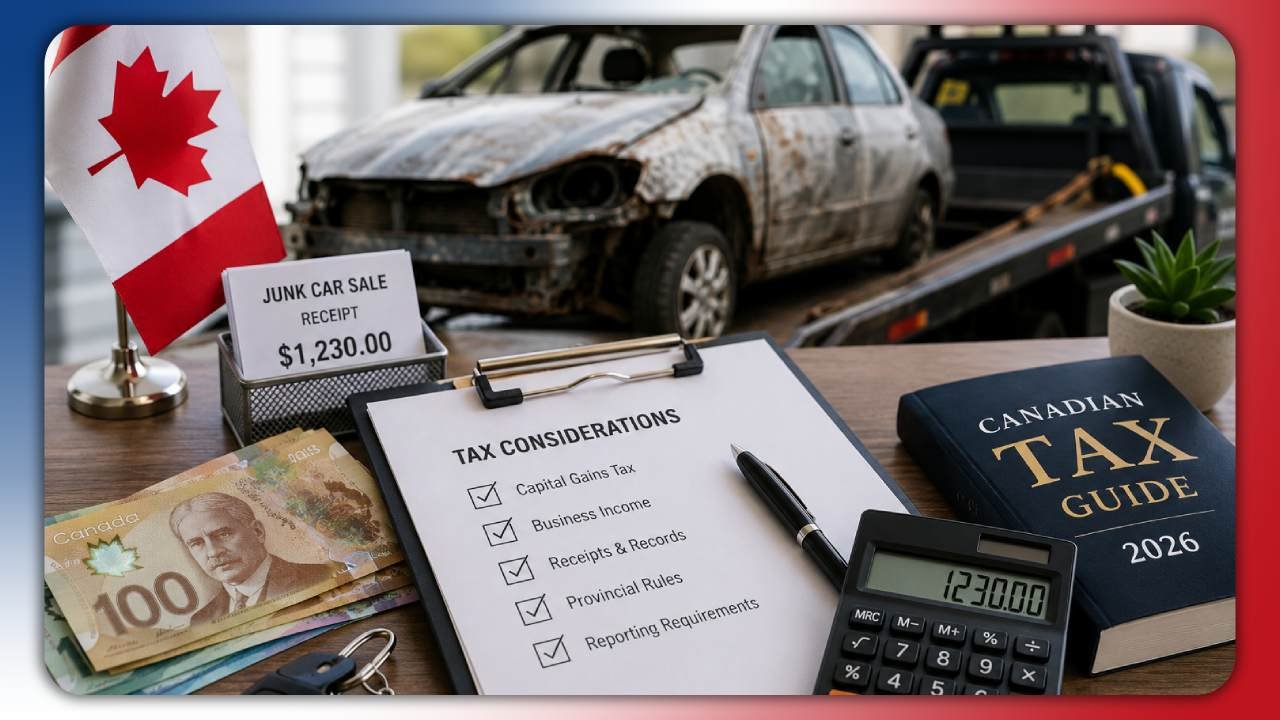
You do not pay tax on selling a junk car in Canada in most personal situations. The Canada Revenue Agency (CRA) treats a personal vehicle as personal-use property, so a private scrap sale rarely triggers capital gains tax.
Tax on selling a junk car in Canada only becomes a real issue in 3 specific cases: business use, a profitable resale, and frequent flipping. This guide breaks down the federal rules, the provincial sales tax rules, and the exact forms you need for 2026. You will also see a quick-reference table and 5 direct answers to common questions before you scrap your vehicle.
Do You Pay Tax on Selling a Junk Car in Canada?
No, you do not owe tax in the average junk car sale.
The CRA classifies your personal car as personal-use property under the Income Tax Act. Personal-use property only creates a taxable capital gain when you sell it for more than $1,000 and more than your original cost. A typical junk car sells for $150 to $800 in 2026, far below its original purchase price.
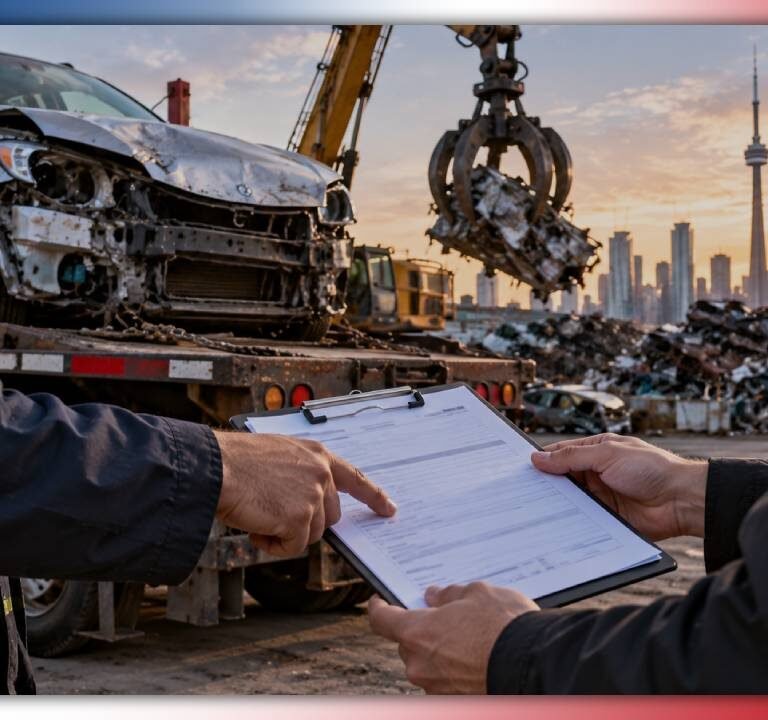
This means most sellers report a capital loss, not a gain, and personal-use losses are not deductible or taxable. You still need a bill of sale and a Vehicle Transfer Notification if you sell in Ontario. Keep both documents in a folder with your registration, insurance cancellation, and any repair receipts.
A licensed scrap buyer will usually prepare this paperwork for you on pickup day.
How the Canada Revenue Agency Classifies a Junk Car Sale
The CRA sorts every vehicle sale into 1 of 3 categories: personal-use property, business asset, or inventory. Personal-use property covers cars you drive for commuting, errands, and family trips.
Business assets include vehicles you claimed Capital Cost Allowance (CCA) on for work use, such as a contractor’s van or a delivery hatchback. Inventory applies to vehicles you buy and resell for profit, like a side hustle flipping cars, trucks, and SUVs.
Each category carries a different tax on selling a junk car in Canada outcome, so identify your category before you file. A mechanic who buys 5 wrecks a year to part out runs a business, not a personal disposal. A homeowner scrapping 1 family sedan after 15 years of use falls under personal-use property instead. Review your last 12 months of vehicle transactions before you assume your category, since patterns matter more than a single sale.
Capital Gains Tax Rules for Personal Vehicle Sales
A capital gain only applies when your sale price exceeds your adjusted cost base. Your adjusted cost base includes the purchase price plus costs like new tires, a rebuilt transmission, or fresh body panels.
Subtract your adjusted cost base from your sale price to find your gain or loss. A positive number is a capital gain and gets reported on Schedule 3 of your tax return. A negative number is a capital loss on personal-use property, and the CRA does not let you claim it.
Most sellers of a junk car end up with a loss, since depreciation outpaces any repair spending. A 2016 sedan bought for $18,000 and scrapped for $400 shows a clear loss, not a gain.
Gifted or Inherited Vehicles
A gifted or inherited car uses its fair market value on the transfer date as the cost base. You only owe tax on selling a junk car in Canada if your sale price beats that fair market value. Ask an appraiser or check the Canadian Red Book for a fair value estimate.
Keep the appraisal with your tax records for 6 years in case the CRA asks. A vehicle worth $2,500 at inheritance and scrapped for $600 creates zero taxable gain.
Vehicles Used Partly for Business
A vehicle used partly for business splits its sale into 2 portions for tax purposes. The personal-use portion follows the standard capital gains rules above. The business-use portion may trigger CCA recapture, covered in the business section below.
Track your business-use percentage with a mileage log to support your split. A driver who logs 40% business use and 60% personal use divides the sale price the same way.
HST and PST Rules When You Scrap a Car in Ontario
You do not charge Harmonized Sales Tax (HST) when you sell your personal car privately in Ontario. HST only applies when a GST/HST-registered business sells a vehicle as part of its operations.
A private seller and a private buyer complete the transaction without any sales tax collection between them. The buyer instead pays Retail Sales Tax (RST) or Provincial Sales Tax (PST) directly to ServiceOntario when they register the vehicle.
That tax burden falls on the buyer, not on you as the seller, in almost every private transaction. Reputable buyers offering professional scrap car removal handle vehicle deregistration with the Ministry of Transportation Ontario (MTO) so this step never lands on you.
Provincial Sales Tax Rates Across Canada
Every province sets its own rate for used vehicle transfers, and these rates vary widely across the country. Ontario charges 13% HST on the greater of the sale price or wholesale value for private sales.
Alberta charges 0% provincial sales tax, since the province has no PST at all. Nova Scotia charges 14% provincial tax on private used vehicle sales, based on 2025 figures. British Columbia applies a progressive PST scale that rises with the vehicle’s purchase price.
Quebec applies the Quebec Sales Tax (QST) at 9.975% through Revenu Quebec. Manitoba charges 7% Retail Sales Tax on private used vehicle transfers at registration. Saskatchewan charges 6% Provincial Sales Tax on the same type of private transfer.
Confirm your exact rate with your provincial transportation ministry before you finalize a sale.
When You Must Charge HST on a Sale
You must charge and remit HST when you operate as a registered business seller. This applies to a licensed dealer, a registered scrap yard, or a frequent car flipper past a set revenue threshold.
A one-time private seller almost never crosses this threshold from a single junk car sale. Register for a GST/HST number only if your total taxable sales pass $30,000 across 4 consecutive quarters.
Tax on Selling a Junk Car in Canada as a Registered Business
A registered business owner faces different tax on selling a junk car in Canada rules than a private seller does. Business income from vehicle sales gets reported as part of your total business revenue for the year.
You must track cost, sale price, and any CCA claimed on that specific vehicle. The CRA expects consistent, documented reporting across every vehicle your business disposes of. Auto recyclers, tow operators, and part-time car flippers all fall under this stricter reporting standard.
Reporting Business Income on Form T2125
To report business income from a junk car sale, complete Form T2125, Statement of Business or Professional Activities. List your gross vehicle sale revenue in the income section of the form.
Deduct the vehicle’s remaining undepreciated capital cost from that revenue figure. Submit Form T2125 alongside your personal tax return by the April tax deadline each year.
Capital Cost Allowance Recapture Explained
Capital Cost Allowance (CCA) recapture happens when your sale price exceeds the vehicle’s remaining undepreciated value. The CRA adds that excess amount back to your business income as recapture for the year.
This recapture gets taxed at your regular business income rate, not the lower capital gains rate. A terminal loss applies instead if you sell for less than the undepreciated value. A delivery van with $3,000 of undepreciated value sold for $4,500 creates $1,500 of recapture.
How to Report a Junk Car Sale to the CRA
To report a junk car sale to the CRA, match your situation to 1 of 2 paths. Most private sellers never file anything specific to the CRA for a single junk car sale. Report your sale on Schedule 3 only if you calculated an actual capital gain above your cost base.
Business owners report every sale through Form T2125 and their regular business income filing. Contact a certified tax professional if your situation involves gifted vehicles, inheritance, or mixed business use.
Documents You Need to Keep for 6 Years
Keep your bill of sale, your original purchase receipt, and any repair invoices for 6 years. The CRA requires this retention period for all supporting tax documents under the Income Tax Act.
Store your Used Vehicle Information Package (UVIP) and Vehicle Transfer Notification with these records. Add photos of the vehicle’s condition at the time of sale for extra protection.
Residents across Etobicoke, Brampton, and Burlington should also keep the tow receipt from pickup day. Store digital copies in cloud storage plus 1 printed folder as a backup against lost files. A missing document slows down any future CRA inquiry and weakens your reported cost base.
Penalties for Not Reporting a Taxable Junk Car Sale
The CRA charges interest and penalties on unreported capital gains once it discovers the omission. A late-filing penalty starts at 5% of the unpaid tax, plus 1% for every extra month.
Business owners who skip Form T2125 face the same penalty structure plus possible audit flags. Repeated unreported vehicle sales can trigger a full CRA review of your last 6 years of returns.
Report a genuine gain honestly, since the penalty almost always costs more than the original tax owed.
GST and HST Registration for Frequent Sellers
A frequent seller of junk cars, parts, and salvage vehicles may need to register for a GST/HST account. The $30,000 threshold applies to total revenue across 4 consecutive calendar quarters, not just car sales.
Once registered, you must charge HST on every taxable sale and file regular returns with the CRA. Deregister only after your revenue drops below the threshold for a full 12-month period.
A part-time seller of 2 or 3 personal vehicles a year almost never reaches this threshold. Voluntary registration remains an option if you want to claim input tax credits on business expenses early.
How to Avoid Tax Problems When You Scrap Your Car
To avoid tax problems when you scrap your car, follow 4 steps in order. Confirm your vehicle category first: personal-use, business asset, or inventory for resale. Calculate your adjusted cost base before you accept any offer from a buyer.
- Confirm your vehicle category before you list the car
- Calculate your adjusted cost base before you accept an offer
- Request a detailed receipt with sale price, date, and buyer information
- File the correct form only if your numbers show a gain or business income
These 4 steps keep your tax on selling a junk car in Canada situation simple and compliant. Revisit this checklist every time you sell a vehicle, even if your last sale created no tax at all.
Choosing a Licensed Scrap Buyer in Ontario
A licensed scrap buyer issues proper documentation that protects you during a future CRA review. Reputable buyers like Scrap Cars 4 Cash handle the paperwork and confirm your sale details in writing.
Drivers searching for scrap car removal Toronto benefit from same-day pickup and instant payment records. Always confirm a company holds proper Ontario recycling and towing licenses before you commit to a sale.
Quick Reference Table for Junk Car Tax Tasks
The table below lists the 4 core tasks every seller should complete before finalizing a junk car sale.
| Task | Timing | Method | Difficulty |
| Identify vehicle category | Before listing the car | Review CRA personal-use and business rules | Easy |
| Calculate adjusted cost base | Before accepting an offer | Add purchase price plus repair costs | Moderate |
| Complete bill of sale | At the time of sale | Written document signed by both parties | Easy |
| File Schedule 3 or Form T2125 | By the April tax deadline | Report gain or business income to CRA | Moderate |
Frequently Asked Questions
Do You Pay HST When You Scrap Your Own Car in Ontario?
No. A private seller does not charge or collect HST on a personal vehicle sale.
Is Scrap Car Money Considered Taxable Income?
No, in most cases. Scrap money from a personal vehicle is not taxable unless you profit above your cost base.
Do You Need to Report a Junk Car Sale on Your Tax Return?
No, unless you calculated a capital gain or you operate a vehicle-related business.
Can You Deduct a Loss From Selling Your Junk Car?
No. The CRA does not allow deductions for losses on personal-use property.
Does Selling Multiple Junk Cars in a Year Change Your Tax Situation?
Yes. Selling 3 or more vehicles a year can classify you as a business seller under CRA rules.
Conclusion
Tax on selling a junk car in Canada stays simple for the average personal seller in 2026. Confirm your vehicle category, calculate your adjusted cost base, and keep your paperwork for 6 years.
Business sellers and frequent flippers carry extra reporting steps through Form T2125 and Schedule 3, so plan ahead each tax year. A clear paper trail protects you whether you sell 1 family car or several vehicles a year. Contact Scrap Cars 4 Cash today through the cash for junk cars page for a same-day quote and free pickup.