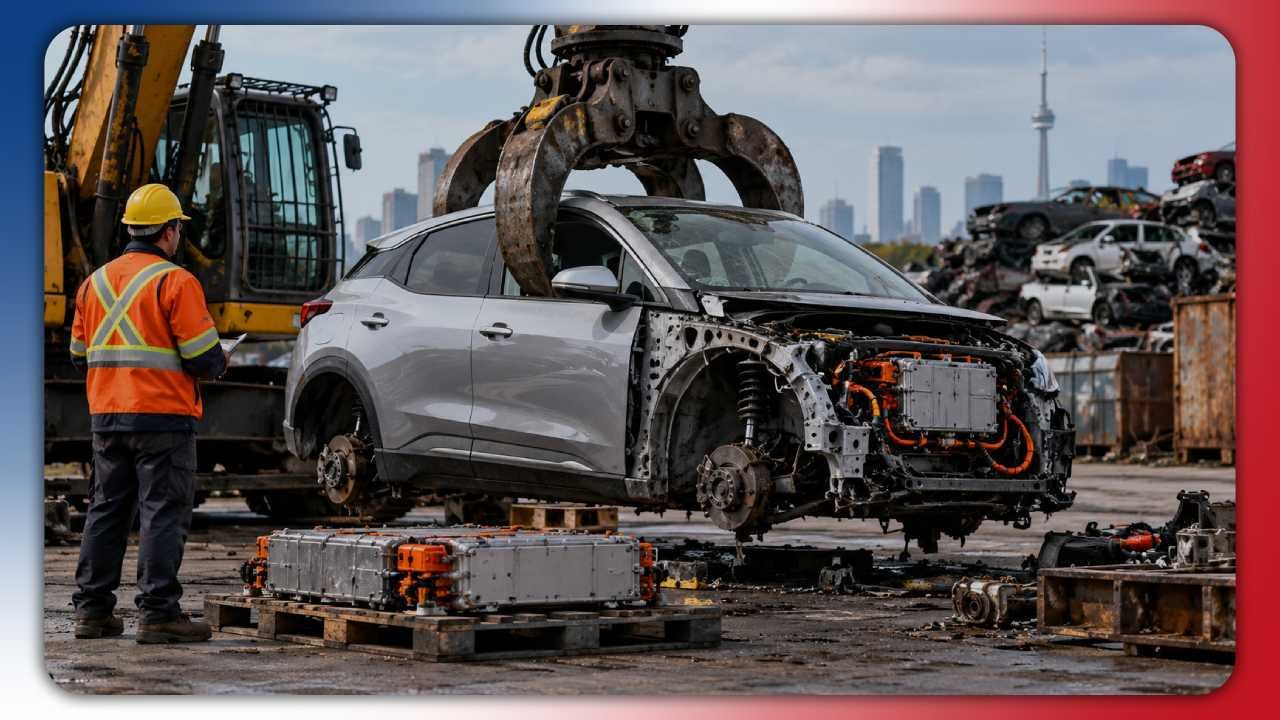
Yes, you can scrap an electric or hybrid car in Ontario in 2026. The scrap electric hybrid car Ontario process follows the same permit, plate, and pickup steps as a gas car sale.
The high-voltage battery in an electric vehicle (EV) or hybrid changes the handling and the quote, not your legal right to sell. Scrap Cars 4 Cash pays $250 to $2,000 for most vehicles in the Greater Toronto Area (GTA), with free towing.
Read the 6 steps, the document list, and the cash ranges below before you call a buyer.
Can You Scrap an Electric or Hybrid Car in Ontario in 2026?
Yes, Ontario allows the registered owner to scrap any electric or hybrid car. You sign the sale, show the vehicle permit, and keep your licence plates.
Scrap Cars 4 Cash accepts running, non-running, flooded, rusted, and totaled vehicles. Every vehicle with 4 wheels receives an offer.
3 Electric and Hybrid Vehicle Types You Can Scrap
Ontario recyclers accept 3 vehicle types, and each type carries a different battery.
- Hybrid electric vehicle (HEV): pairs a gasoline engine with a small battery, such as the Toyota Prius, Honda Insight, or Ford Escape Hybrid.
- Plug-in hybrid electric vehicle (PHEV): adds a larger battery and a charge port, such as the Toyota Prius Prime or Chevrolet Volt.
- Battery electric vehicle (BEV): runs on a battery pack alone, such as the Nissan Leaf, Chevrolet Bolt, or Tesla Model 3.
Scrap Cars 4 Cash assesses all 3 types by year, make, model, and condition.
Which Ontario Rules Apply When You Scrap a Hybrid or EV
Ontario businesses that process more than 2 end-of-life vehicles (ELVs) must register on the Environmental Activity and Sector Registry (EASR). Check the registration of your buyer before you sign.
The Automotive Recyclers of Canada (ARC) holds members to the Canadian Automotive Recyclers Environmental Code (CAREC). Report illegal operators to the provincial environment ministry.
When Should You Scrap a Hybrid or EV Instead of Repairing It?
Scrap a hybrid or EV when the repair cost exceeds the market value of the vehicle. Compare written estimates with the realistic value of the vehicle before the damage.
5 Signs Your Hybrid or EV Has Reached End of Life
- Battery failure: replacement packs cost up to $20,000, which can exceed the value of an older vehicle.
- Total-loss collision: the insurer declares repair costs higher than the vehicle value.
- Failed safety inspection: rust, suspension, and brake repairs cost more than the vehicle earns.
- Long storage: seized brakes, flat tires, and dead 12-volt batteries block movement.
- Mechanical failure: engine, inverter, and drive motor faults outweigh the resale value.
Ontario requires a Safety Standards Certificate (SSC) before a used vehicle returns to the road. Costly repairs for the certificate push many owners toward scrapping.
How Hybrid and EV Batteries Change the Scrap Process
Recyclers remove the high-voltage battery before they crush or shred the vehicle. Traction batteries operate above 60 volts, so trained dismantlers disconnect the system first.
ARC reports that Canada processes about 1.6 million end-of-life vehicles each year. Newer total-loss vehicles form a significant share of the total.
What Happens to the High-Voltage Battery After Pickup
Recyclers choose 1 of 3 routes for a retired battery pack.
- Reuse: recyclers inspect packs and resell them to repair another vehicle.
- Second life: companies repurpose packs as backup power for buildings and solar storage.
- Material recovery: refiners extract lithium, nickel, and cobalt for new batteries.
Battery age and health set the value. Lithium-ion (Li-ion) packs last 5 to 15 years, or 500 to 1,500 charge cycles. A first-generation Nissan Leaf pack weighs about 650 pounds (295 kg).
Replacement packs cost up to $20,000, so recyclers value intact packs for reuse. Electric motors also contain permanent magnets, and companies such as Cyclic Materials recover them.
What Recyclers Recover Beyond the Battery
Depollution removes coolant, air conditioning refrigerant, and brake fluid from every vehicle. Hybrids also release engine oil and gasoline.
Dismantlers then recover aluminum, steel, copper, and electric motors. Aluminum body panels raise the scrap value, and metal prices shift weekly.
Why Hybrid Catalytic Converters Still Matter
Hybrids keep a gasoline engine, so the exhaust system still carries a catalytic converter. BEVs carry no converter.
Do not remove the converter before you scrap the car. Removal lowers the vehicle offer and complicates towing, and the catalytic converter buying page explains the code-based quote for removed units.
Scrap Electric Hybrid Car Ontario Cash Ranges in 2026
Scrap Cars 4 Cash pays $250 to $2,000 for most GTA vehicles, and larger trucks and newer write-offs pay more. The company publishes typical ranges by vehicle type on its Mississauga service page.
- Compact cars and sedans: $250 to $500
- Mid-size and full-size cars: $350 to $700
- Sport utility vehicles (SUVs) and crossovers: $450 to $1,000
- Pickup trucks and vans: $600 to $1,500
- Late-model, low-kilometre vehicles: $1,200 to $2,000
- Accident-damaged or non-running vehicles: $250 to $800
Ranges are estimates. Every quote reflects the exact vehicle, so each hybrid or EV receives an individual assessment.
5 Factors That Set Your Hybrid or EV Cash Offer
The team explains all 5 factors before you accept the quote.
- Vehicle weight: heavier vehicles contain more recyclable steel.
- Make and model: popular engines, transmissions, and electronics raise the offer above metal value.
- Condition: a complete vehicle earns more than a stripped vehicle.
- Scrap metal prices: steel and metal prices shift weekly.
- Pickup location: accessible GTA locations cost less to tow.
A missing battery, converter, or set of wheels lowers the offer.
How to Scrap an Electric or Hybrid Car in Ontario in 6 Steps
To scrap an electric or hybrid car in Ontario, complete these 6 steps in order.
- Confirm ownership: match the Vehicle Identification Number (VIN) on your permit to the vehicle, then clear any lien.
- Photograph the vehicle: capture the front, rear, both sides, interior, and any damage.
- Request a quote: call +1 437-269-6321, message WhatsApp, or submit the online form with the year, make, model, and condition.
- Book the pickup: choose a same-day or next-day slot, including evenings and weekends.
- Prepare the vehicle: remove the plates and belongings, and unplug the charging cable.
- Complete the handover: show your permit and photo identification, then receive payment at pickup.
Use the quick-reference table to plan your timeline.
| Task | Timing | Method | Difficulty |
| Confirm ownership and liens | 1 day | Check the permit, VIN, and lender balance | Easy |
| Photograph the vehicle | 10 minutes | Take 6 phone photos | Easy |
| Request a quote | 5 minutes | Call, WhatsApp, or use the online form | Easy |
| Book the pickup | Same day or next day | Choose a time slot | Easy |
| Remove the plates | 15 minutes | Use a 10mm (0.4 in) socket or Phillips screwdriver | Easy |
| Unplug the charging cable | 5 minutes | Coil the cable and clear the charge port area | Easy |
| Complete the handover | At pickup | Show the permit and photo identification | Easy |
| Cancel the insurance | 1 day | Call your insurer after pickup | Easy |
How to Prepare Your Hybrid or EV for Pickup
To prepare your hybrid or EV for pickup, unplug the charging cable and clear a path 10 feet (3m) wide for the truck.
Tell the dispatcher whether the vehicle starts, rolls, steers, and has keys. Keep the key fob ready, because neutral mode on many EVs and hybrids needs the fob.
Leave the orange high-voltage cables alone. Manufacturers commonly specify flatbed towing for EVs, and flatbed transport protects the electric motors. Measure the clearance of underground garages in feet (metres) and share the number.
How to Remove Your Licence Plates in Ontario
To remove your licence plates in Ontario, loosen both plate screws with a 10mm (0.4 in) socket or a Phillips screwdriver. Keep the plate portion of your permit, because Ontario plates stay with you, not the vehicle.
What Happens on Pickup Day
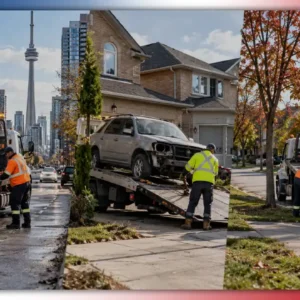
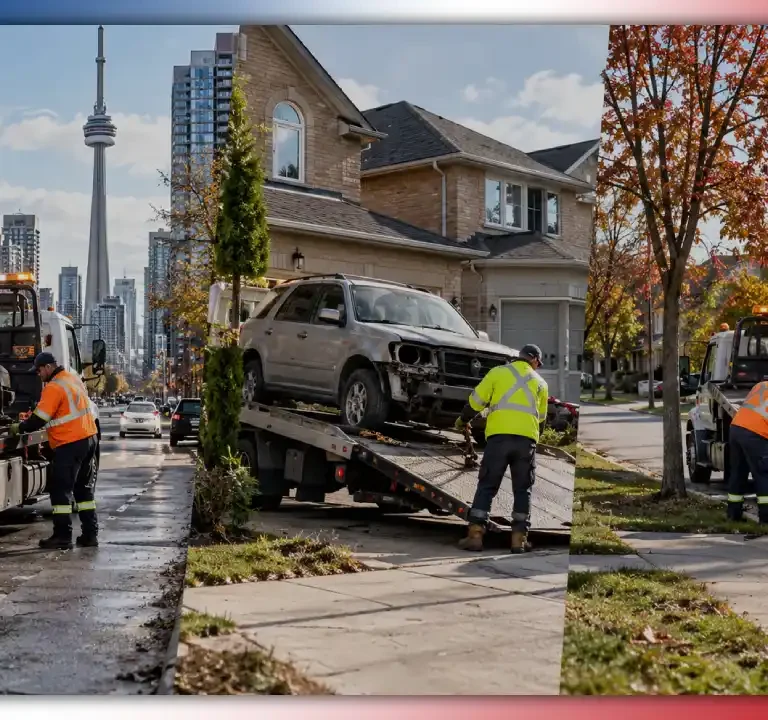
On pickup day, a registered driver arrives at your address, checks the VIN, and loads the vehicle onto the truck. The driver completes the ownership transfer paperwork, and you receive payment. Most pickups finish within 24 hours of your first call.
5 Mistakes That Lower Your Hybrid or EV Offer
Avoid these 5 mistakes before you call a buyer.
- Removing the catalytic converter before you request a whole-vehicle quote
- Skipping the lien check on a financed vehicle
- Leaving the licence plates on the vehicle
- Hiding the battery status or the collision damage
- Blocking truck access with parked cars
Which Documents You Need to Scrap a Hybrid or EV in Ontario
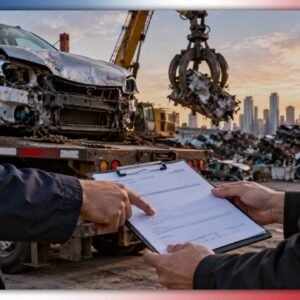
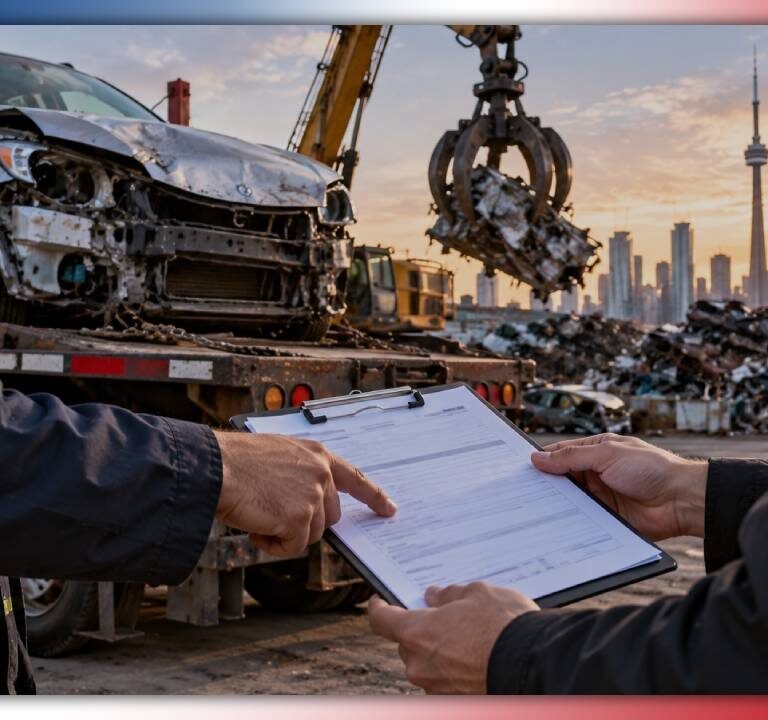
Bring your Ontario vehicle permit and government-issued photo identification that matches the registered owner. Scrap Cars 4 Cash handles the ownership transfer and deregistration with the Ministry of Transportation of Ontario (MTO).
- Vehicle permit: shows the owner name and the VIN
- Photo identification: matches the name on the permit
- Lien discharge: proves the lender released a registered interest
- Bill of sale: records the buyer, seller, date, and price
- Release authorization: covers vehicles held at a body shop or impound lot
Lost your permit? Tell the dispatcher when you call, and the team can usually still process the sale. A Used Vehicle Information Package (UVIP) shows the registration history and registered liens.
Cancel your auto insurance after pickup to stop paying for a vehicle you no longer own.
Can You Scrap a Damaged or Non-Running Electric or Hybrid Car?
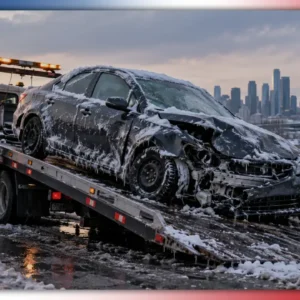
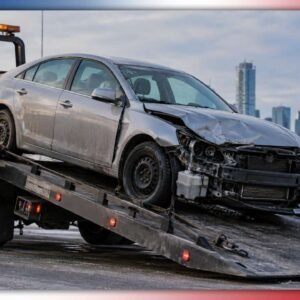
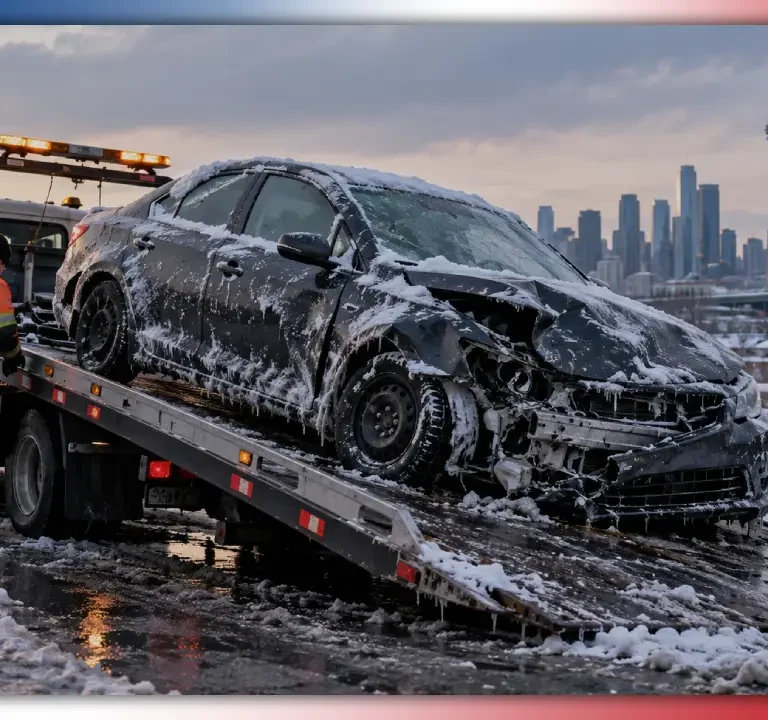
Yes, you can scrap a crashed, flooded, or non-running hybrid or EV. Scrap Cars 4 Cash treats accident-damaged car removal as a standard service and includes towing with accepted pickups.
Damaged vehicles need extra planning because impact can harm the battery pack. Plug’n Drive president Cara Clairman said in 2024 that crashed vehicles supply most battery waste.
How to Report Collision Damage Before Towing
To report collision damage before towing, send 6 photos: front, rear, left side, right side, interior, and the main damaged area. Add the VIN and state whether the airbags deployed.
Describe any leak, smell, or heat from the battery pack. Call 911 if the pack smokes or heats.
Which Ownership Checks Apply After a Total Loss
Confirm 3 items before you sell a total-loss hybrid or EV. Do not sell after you sign ownership to the insurer.
- Insurer decision: confirm the insurer released its claim or allowed owner-retained salvage.
- Lender balance: confirm whether a lender holds a registered interest.
- Facility release: obtain written release from the body shop or impound lot.
Should You Scrap, Sell, or Trade In Your Hybrid or EV?
Scrap your hybrid or EV when repairs cost more than the vehicle value or the vehicle no longer runs. Other routes suit running vehicles with strong demand.
- Scrap: suits old, damaged, and non-running vehicles, with free towing and same-day cash.
- Private sale: suits running hybrids with clean records, but brings photos, messages, and test drives.
- Trade-in: suits buyers of another vehicle, because the trade-in value reduces the sales tax on the new purchase.
Compare 2 quotes: 1 from a general scrap buyer and 1 from a hybrid or EV specialist. Buyers value batteries differently, so 2 quotes reveal the spread.
5 Checks Before You Pick a Scrap Electric Hybrid Car Ontario Buyer
Pick a buyer that holds proper registration, explains battery handling, and tows for free. Run these 5 checks before you accept any offer.
- Verify registration: confirm the buyer operates as a registered ELV waste disposal site on the EASR.
- Check memberships: look for ARC or Ontario Automotive Recyclers Association (OARA) membership.
- Ask about batteries: request the name of the facility that receives the high-voltage pack.
- Lock the terms: confirm the offer, towing cost, and payment method before dispatch.
- Read the reviews: compare Google ratings, such as the 5 out of 5 from 9 reviews at Scrap Cars 4 Cash.
Scrap Cars 4 Cash operates as a registered Ontario vehicle recycler from 66 Milvan Dr, North York, ON M9L 2B3. The team serves Toronto and the GTA across 20 listed service areas, including Mississauga, Brampton, Vaughan, Markham, Richmond Hill, and Oakville.
Frequently Asked Questions About Scrapping Electric and Hybrid Cars in Ontario
Can You Scrap an Electric Car With a Dead Battery in Ontario?
Yes. Scrap Cars 4 Cash accepts non-running vehicles in any condition, and the battery condition adjusts the quote.
Do You Need to Remove the Battery Before Scrapping a Hybrid?
No. Leave the battery installed, and the recycler removes the high-voltage pack after pickup.
Is Towing Free When You Scrap a Hybrid or EV?
Yes. Scrap Cars 4 Cash tows vehicles free anywhere in the GTA, and flatbed trucks move vehicles that cannot roll.
Can You Scrap a Financed or Leased Hybrid or EV?
No, not until the lender releases the lien. Obtain the lender discharge information before the sale.
Does the Driver Pay Cash at Pickup?
Yes. Scrap Cars 4 Cash pays at pickup after the driver verifies the vehicle, and you confirm the payment terms before dispatch.
Get a Free Quote to Scrap Your Electric or Hybrid Car in 2026
Call +1 437-269-6321 to get a free, no-obligation quote for your hybrid or EV. Send the year, make, model, and condition, and the team confirms the offer before pickup. Book the scrap car removal service today for free towing across Toronto and the GTA.