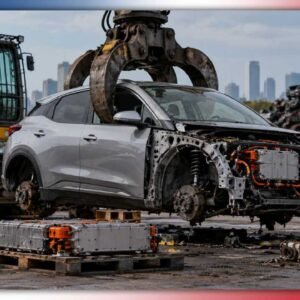
The most money for your scrap car comes from combining 4 steps: knowing your vehicle’s exact scrap weight, removing high-value parts before pickup, collecting at least 3 competing quotes, and timing your sale to coincide with strong scrap metal markets. The gap between an unprepared seller and one who works these 4 levers is real, $300 to over $800 (CAD) on the same vehicle. A non-running 2010 Honda Civic sitting in a Mississauga driveway can pay anywhere from $180 at a basic weight-only yard to $620 at a parts-aware recycler, depending purely on how the seller handles the transaction.
This guide gives you exact numbers for Ontario, a step-by-step action plan, and the 5 questions to ask every buyer before you hand over the keys. Whether your car is in Toronto, Brampton, Scarborough, Vaughan, or anywhere across the GTA, these moves apply the same way.
How Scrap Yards Calculate Your Car’s Value in Ontario
2 pricing models decide what your scrap car is worth: weight-based pricing and parts-based pricing. Weight-based buyers pay per kilogram (or pound) of scrap metal. Parts-based buyers assess what your engine, catalytic converter, transmission, and wheels can sell for, then add that to the metal value. Parts-based buyers consistently pay 30% to 60% more than weight-only yards on the same vehicle.
Weight-based pricing uses a simple formula:
- Auto body steel: CAD $0.22 to $0.33 per kg ($0.10 to $0.15 per lb) in Ontario as of mid-2026.
- Aluminum components: CAD $0.55 to $1.32 per kg ($0.25 to $0.60 per lb), depending on alloy grade.
- Cast iron engine blocks: CAD $0.11 to $0.22 per kg ($0.05 to $0.10 per lb).
Parts-based recyclers layer resale value on top of this baseline. A catalytic converter alone can add $150 to $800 to your payout before the buyer touches the rest of the car.
Scrap Car Value by Vehicle Class: Weight Ranges and Baseline Payouts
Heavier vehicles always generate higher baseline scrap payouts, since buyers pay by the tonne of steel and aluminum. A full-size pickup carries twice the metal of a compact hatchback, which shows up directly in the quote. This table gives you the weight ranges and typical steel-only baseline for each vehicle class at mid-2026 Ontario rates.
| Vehicle Class | Weight (kg) | Weight (lbs) | Steel Baseline (CAD) |
| Compact sedan/hatchback | 1,100–1,300 kg | 2,400–2,900 lbs | $240–$430 |
| Mid-size sedan/crossover | 1,400–1,700 kg | 3,100–3,750 lbs | $310–$560 |
| Full-size SUV | 1,900–2,400 kg | 4,200–5,300 lbs | $420–$790 |
| Half-ton pickup (F-150, RAM 1500) | 1,900–2,200 kg | 4,200–4,850 lbs | $420–$725 |
| Three-quarter / full-ton truck | 2,400–3,200 kg | 5,300–7,000 lbs | $530–$1,050 |
| Full-size van (Transit, Express) | 2,000–2,800 kg | 4,400–6,200 lbs | $440–$925 |
These are steel-only baselines before parts. Add catalytic converter, battery, and wheel values on top, and the final payout climbs significantly above the figures above.
6 Most Valuable Parts to Pull Before Scrapping Your Car
Pulling 1 to 3 high-value components before a whole-car sale is where most Ontario sellers leave the most money on the table. Every part listed below can be sold separately in under a day via Kijiji, Facebook Marketplace, or a specialist buyer, adding straight to your total return with no extra towing cost.
1. Catalytic Converter $50 to $1,500+
The catalytic converter is your single biggest opportunity. It contains platinum, palladium, and rhodium, 3 precious metals with market-driven resale value that changes weekly. Standard passenger car converters pay $50 to $300. Toyota and Honda converters, especially from Prius, Camry, Accord, and CR-V models, pay $300 to $1,500 because their platinum loading is higher. Sell to a dedicated catalytic converter buyer rather than including it in a whole-car offer: whole-car buyers typically discount their estimate when they know the converter is intact, since they factor in buying it from you.
2. 12-Volt Lead-Acid Battery $20 to $50
A working 12V battery sells for $20 to $50 at auto shops, scrap yards, or directly on Kijiji. Hybrid battery packs Toyota Prius, Ford Escape Hybrid, Honda Insight sell for $200 to $600 depending on capacity and cell condition. Remove it with a wrench in 10 minutes. Most buyers pay more when the battery tests above 75% charge with a multimeter check.
3. Alloy or Aftermarket Wheels $100 to $500 per set
OEM alloy wheels from popular GTA vehicles (Honda Civic, Toyota Corolla, Ford F-150, Jeep Grand Cherokee) sell for $100 to $400 per set if undamaged. Aftermarket rims in good condition can exceed $500. Steel wheels almost never justify removal scrap buyers treat them as part of the car’s base weight.
4. Undeployed Airbags $50 to $200 per unit
Body shops and collision repair centres pay $50 to $200 per unused OEM airbag module. Only remove airbags if you have the technical knowledge to do so safely they’re explosive devices under pressure. Deployed or missing airbags don’t affect a scrap buyer’s quote, so there’s no cost to leaving them in if you’d rather not deal with them.
5. Usable Tires $25 to $75 each
Tires with 4 mm (0.16 in) or more of tread depth sell individually for $25 to $75 each on Facebook Marketplace. A matching set of 4 tires in good condition moves faster and commands a small premium. Bald, cracked, or seasonal tires with remaining tread below 2 mm generally aren’t worth the effort to remove.
6. Aftermarket GPS or Infotainment Units $50 to $300
Aftermarket navigation units, dash cameras, and branded audio systems sell for $50 to $300 depending on brand and model year. Factory-installed infotainment screens in newer vehicles (2018+) can command more if the unit is VIN-coded to a popular model with strong Kijiji demand.
Important: confirm with your buyer before removing anything. Some cash for cars buyers adjust their quote downward for missing high-value parts usually the catalytic converter. Ask directly: “Do you pay the same price if the catalytic converter is already removed?” before you touch a thing.
When Scrap Metal Prices Are Highest and How Much Timing Is Worth
Spring (March to June) delivers the highest scrap metal prices in Ontario, driven by construction season demand for steel and manufacturing ramp-ups that absorb recycled aluminum. Sellers who wait for this window instead of selling in January or February typically see 10% to 20% higher per-kg rates, which on a full-size SUV or pickup can translate to an extra $50 to $150 (CAD) on the final quote.
| Season | Typical Market Trend | Impact on a Mid-Size SUV |
| Mar–Jun (Spring) | Highest construction demand peaks | +$50 to +$150 vs. winter baseline |
| Jul–Sep (Summer) | Moderately high, stable | Near spring peak |
| Oct–Nov (Fall) | Softening, pre-winter slowdown | Slight dip from summer |
| Dec–Feb (Winter) | Lowest construction slowdown | Lowest payouts of the year |
If timing is flexible, sell between March and June. If you need cash now and it’s January, a junk car pickup service that factors parts value into the offer can partially offset the lower metal rate by up to $200.
5 Questions to Ask Every Scrap Car Buyer Before Accepting a Quote
Most Ontario sellers accept the first quote they receive, which is almost always $100 to $300 below what a second or third call produces. Buyers know first-callers rarely shop around. These 5 questions level the playing field before you commit.
- “Is free towing included in the quote, or deducted from it?” Some buyers advertise $500 offers, then deduct a $75 towing fee on pickup. Confirm total payout, not the advertised number.
- “Do you use today’s scrap metal rate in your quote?” Buyers who quote from last week’s rates on a rising market are already undercutting you. Real-time pricing protects your payout.
- “What happens to the quote if the catalytic converter is already removed?” This tells you exactly what the converter is worth to that buyer before you decide whether to pull it.
- “Do you handle the Ontario MTO ownership transfer, or is that on me?” Legitimate scrap car removal services process the ownership transfer and handle the green slip on pickup. If they don’t, you carry the liability.
- “Can I get the quote in writing before pickup?” Any buyer unwilling to confirm a quote in writing or by text before arriving should be avoided. Verbal promises drop at the moment the truck rolls into your driveway.
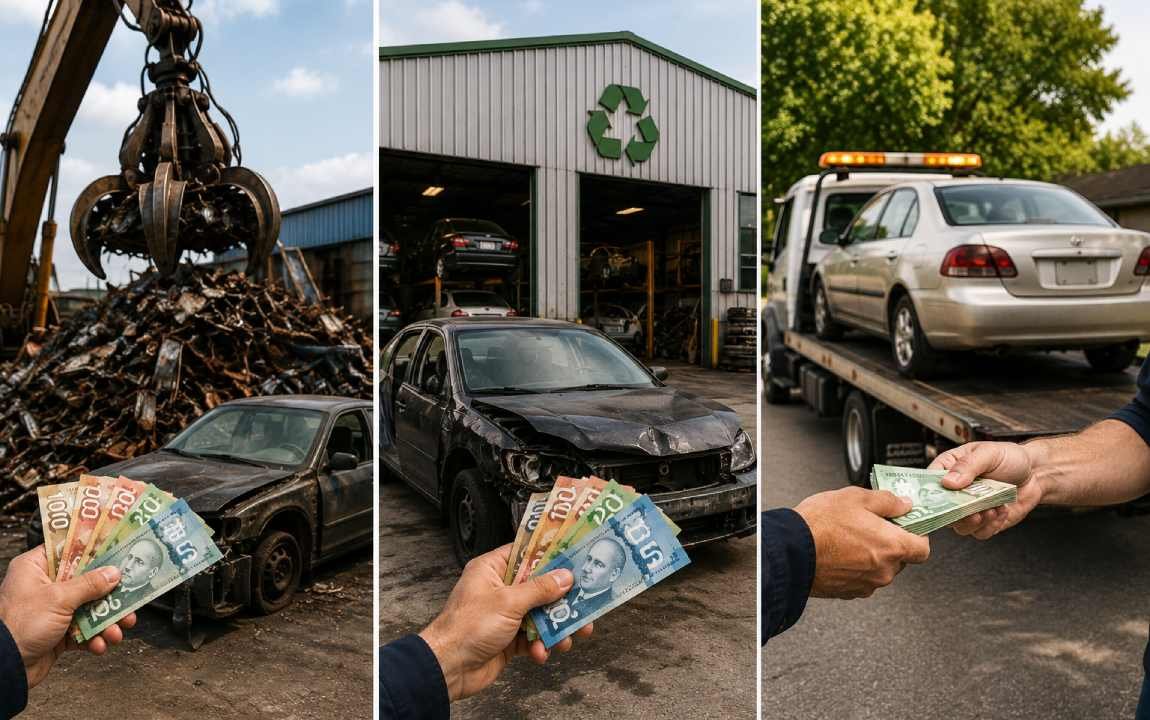
Scrap Yard vs. Auto Recycler vs. Cash-for-Cars: Who Pays More in Ontario?
A cash-for-cars service that factors in parts value almost always outpays a basic scrap yard by 30% to 60% on the same vehicle. The table below compares the 3 main buyer types on the factors that matter most to Ontario sellers.
| Feature | Basic Scrap Yard | Auto Recycler | Cash-for-Cars Service |
| Pricing method | Weight only | Weight + parts | Weight + parts + speed |
| Typical payout (compact) | $100–$300 | $300–$550 | $250–$620 |
| Typical payout (full-size SUV) | $300–$500 | $500–$1,100 | $450–$1,000+ |
| Free towing included | Rarely | Sometimes | Almost always |
| Ownership transfer handled | Usually not | Usually yes | Yes |
| Same-day pickup | 2–5 business days | 1–2 days | Same day to 24 hrs |
| Best for | Stripped vehicles, no parts | Partial cars, OEM parts intact | Any condition, quick cash |
For accidental scrap cars and vehicles with mechanical failure, a cash-for-cars service with parts-aware pricing is typically the top-dollar path. Basic scrap yards make sense only for vehicles that are already stripped down to bare metal.
4 Red Flags That Signal a Low-Ball Scrap Car Buyer
Walk away from any buyer who uses even one of these 4 tactics they signal a buyer whose business model depends on sellers not knowing their vehicle’s real value.
- Quote drops at pickup. Any quote issued by phone or online is a commitment. A buyer who suddenly cites “condition issues” when the tow truck arrives, without a specific defect they couldn’t have mentioned upfront, is using a bait-and-switch. Legitimate quotes hold at pickup.
- Upfront fees of any kind. Towing, fuel, admin, and documentation fees belong entirely on the buyer’s side of a scrap car transaction. If a buyer charges you to pick up your car, find someone else.
- Unverifiable business address or no Ontario licensing. Auto recyclers in Ontario operate under provincial regulations. Ask for a business address and look it up on Google Maps before agreeing to anything.
- Pressure to sign the ownership transfer before payment. The green ownership slip only changes hands when cash is in your hand. Any buyer who rushes you to sign before paying is creating a liability gap in your favour of exactly zero.
Step-by-Step: How to Maximize Your Scrap Car Payout in Ontario
These 6 steps in order produce the highest total return:
- Find your vehicle’s curb weight using the owner’s manual, the manufacturer’s website, or a free VIN decoder. This is your baseline for calculating what a weight-only quote should be, and for spotting lowball offers.
- Research your catalytic converter model using the VIN and your car’s make, model, and year. Toyota, Honda, and Ford converters from 2006 to 2020 tend to carry the highest precious-metal loadings and pay the most to specialist buyers.
- Pull the catalytic converter, battery, and any alloy wheels if you have basic mechanical access and a confirmed buyer for each. Confirm first that your main scrap buyer doesn’t deduct for missing parts.
- Call 3 to 5 buyers covering at least one weight-only yard, one auto recycler, and one cash-for-cars service. Use the 5 questions from the section above on every call. Record the best all-in offer.
- Check current scrap metal prices on a Canadian scrap index before your calls. If steel is at 6-month highs, push harder for a higher quote. If prices dropped last week, accept a fair offer now rather than holding out for a market that may not recover quickly.
- Confirm free towing, same-day pickup, and ownership transfer handling in writing before confirming the appointment. Remove your licence plates, clear your personal items, and have the green ownership slip ready to sign over on pickup.
Scrap Cars 4 Cash covers all of our service areas across the GTA Toronto, Mississauga, Brampton, Vaughan, Markham, Scarborough, North York, Richmond Hill, Ajax, Whitby, Oshawa, and beyond with same-day pickup and cash paid before the vehicle leaves your property.
Frequently Asked Questions
How much can I get for scrapping my car in Ontario?
Most scrap cars in Ontario pay $150 to $1,000+ (CAD), depending on vehicle weight, parts intact, the buyer type, and current scrap metal prices. A compact sedan at a weight-only yard pays $150 to $300. The same car at a parts-aware cash-for-cars service with an intact catalytic converter pays $400 to $620 or more.
What is my junk car worth if it doesn’t run?
A non-running car’s scrap value is based entirely on its metal weight and intact parts not whether it starts. A non-running full-size SUV with all major components still attached pays $400 to $900 at a parts-aware buyer. Scrap buyers don’t care about mechanical condition since the vehicle is recycled, not resold.
Should I sell my car for parts or scrap the whole thing?
Parting out maximizes total return but takes weeks of effort; scrapping the whole car is faster and still pays well if you choose a buyer that factors in parts value. Pull only the catalytic converter and battery if you want the best balance of extra cash and minimal time invested these 2 parts account for the biggest gap between buyer types.
When are scrap car prices highest in Canada?
Scrap car prices are highest in Ontario from March to June, when construction-season demand for recycled steel and aluminum peaks. Prices in this window run 10% to 20% above December and January lows, which on a mid-size vehicle adds $50 to $150 to your payout.
Do I need the title to scrap a car in Ontario?
Yes, Ontario requires the green Vehicle Ownership Certificate signed over to the buyer and valid photo ID to legally transfer a scrap vehicle. If the title is lost, apply for a replacement at ServiceOntario before selling. Legitimate buyers process the MTO transfer on pickup and handle the paperwork for you.
What parts are most valuable when scrapping a car?
The catalytic converter, hybrid battery pack (where applicable), alloy wheels, a working 12V battery, and undeployed airbags are the 5 most valuable parts on most Ontario scrap vehicles. The catalytic converter alone can add $150 to $1,500 to your total return depending on your vehicle’s make and model.
How do I avoid getting scammed by a junk car buyer?
Get the quote confirmed in writing before the tow truck arrives, confirm free towing is included in the total offer, and never hand over the ownership slip before cash is in your hand. Any buyer who drops the quote on arrival without a new specific reason, charges upfront fees, or rushes ownership transfer before payment is not operating legitimately.
Get the Most Money for Your Scrap Car Today
Scrap Cars 4 Cash pays based on real-time Ontario scrap metal rates plus parts value, not a flat lowball number. Free same-day towing across the entire GTA, cash paid on the spot, and full MTO ownership transfer handled on pickup. Call +1 437-269-6321 or get a free quote online and find out exactly what your scrap car is worth today.
Sources: Ontario Ministry of Transportation Vehicle Ownership Transfer (ontario.ca); Natural Resources Canada Steel Recycling