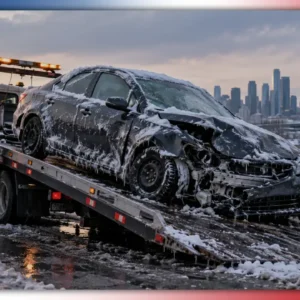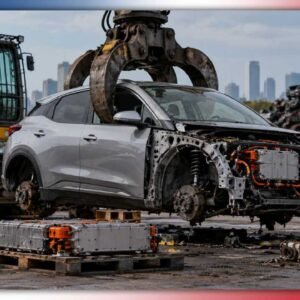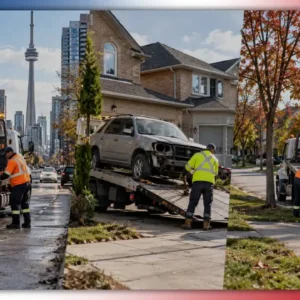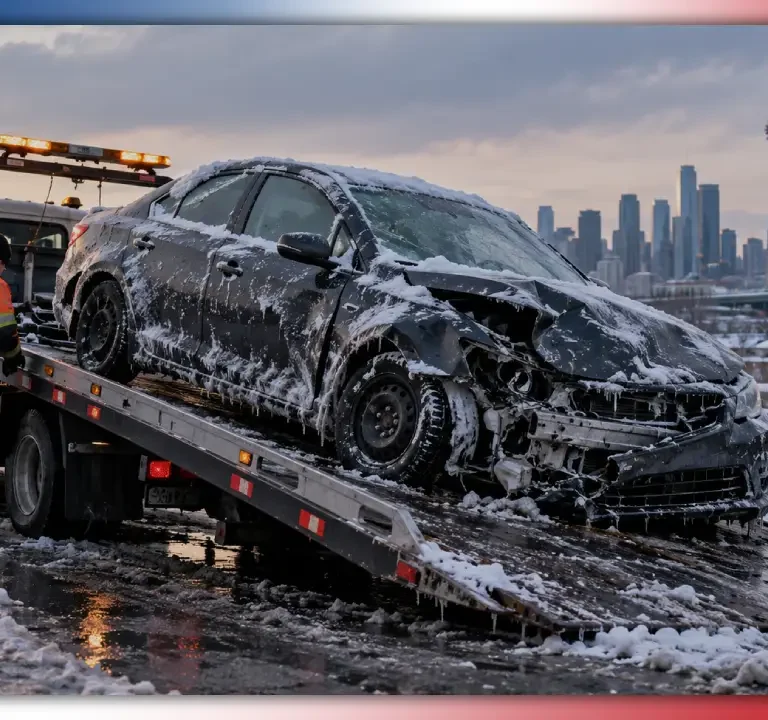
Yes, licensed scrap car buyers in Toronto handle electric and hybrid vehicles in 2026, including Teslas, Priuses, and Nissan Leafs. You do not need to remove the battery yourself or search for a specialty yard.
Electric vehicle (EV) ownership keeps climbing across the Greater Toronto Area (GTA), and end-of-life EV volume grows with it every year. A certified recycler collects your car, extracts the battery safely, and pays you cash the same day.
This guide walks you through the exact process, shows you what your vehicle is worth, and explains how battery recycling works in Toronto in 2026.
Natural Resources Canada reports that zero-emission vehicles now account for over 10% of new car sales nationwide. That growth means thousands of Toronto-area EVs and hybrids will reach end-of-life status within the next 5 years.
Do Scrap Car Buyers in Toronto Accept Electric and Hybrid Vehicles?
Yes, most licensed scrap car buyers in Toronto accept electric and hybrid vehicles today. Not every yard holds the certification required, so you should confirm this detail before booking a pickup.
A certified recycler in Toronto processes 3 vehicle categories every week: gas-powered cars, hybrids such as the Toyota Prius and Honda Insight, and full electric models such as the Tesla Model 3 and Chevrolet Bolt. Each category follows a different internal process once the vehicle reaches the yard.
You request a free quote by phone or online form, and most companies respond within minutes. A 2018 Nissan Leaf with a degraded battery, for example, still qualifies for same-day pickup, with the battery, plates, and paperwork all handled by the recycler.
Toronto’s EV and hybrid fleet has expanded fast enough that most reputable scrap car removal service providers now train staff specifically for high-voltage vehicles. Ask directly whether a company holds Canadian Auto Recyclers Environmental Code (CAREC) certification before you commit.
Not every yard invests in this training, since certified equipment and insurance both raise operating costs. This gap is exactly why calling ahead and confirming acceptance saves you a wasted trip.
The GTA now processes more end-of-life EVs and hybrids than any other Canadian region, driven by early adoption and a dense population. This volume gives Toronto owners more certified options than owners in smaller Ontario cities.
What Makes Scrapping an Electric or Hybrid Car Different From a Gas Car?
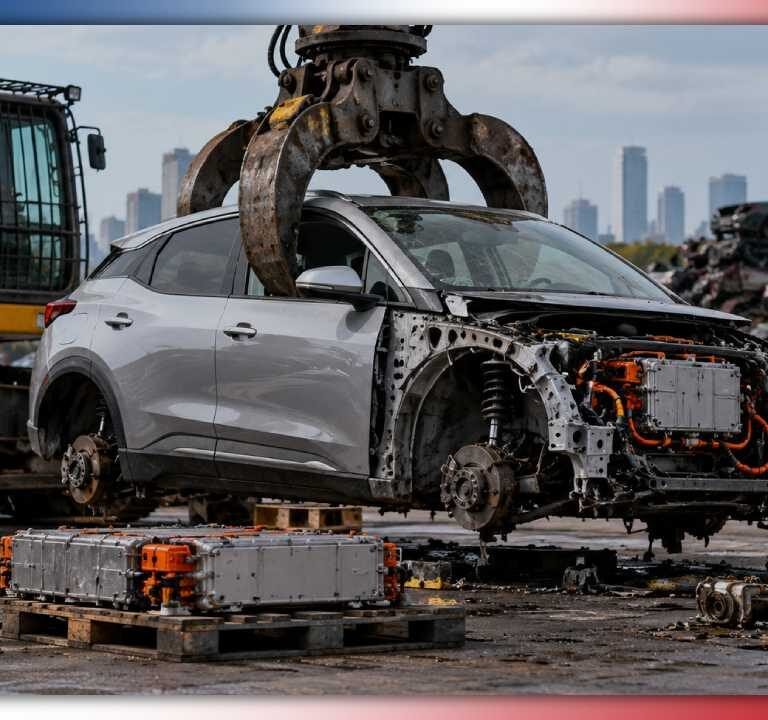
Scrapping an electric or hybrid car requires more certified steps than scrapping a gas car. The battery pack, wiring, and lightweight materials each demand specialist handling.
Gas cars use a single 12-volt battery, steel-heavy construction, and standard fluid drainage. Electric and hybrid vehicles add high-voltage components, aluminum and carbon-fibre body panels, and stricter transport rules for the battery itself.
High-Voltage Battery Packs Need Certified Handling
A lithium-ion or nickel-metal hydride (NiMH) battery pack can hold a lethal charge even after the car stops running. Only a technician trained under CAREC standards may remove it.
These packs weigh between 300 kg and 450 kg (660 lbs and 990 lbs) in a typical EV. Handling one without insulated tools and protective gear creates a serious electric shock risk for anyone nearby.
Hybrid Vehicles Carry Two Separate Battery Systems
A hybrid car carries 2 batteries: a standard 12-volt unit and a high-voltage NiMH or lithium-ion pack. Each battery follows a separate removal and disposal process at a certified yard.
The 12-volt unit gets removed the same way as in a gas car. The high-voltage pack requires the same certified handling used for a full EV.
How to Scrap an Electric or Hybrid Car in Toronto
To scrap an electric or hybrid car in Toronto, you contact a licensed recycler, provide your vehicle details, and schedule a free pickup. The recycler completes every remaining step on your behalf.
Step 1 and 2 – Get a Quote and Gather Your Documents
Call or submit an online form with your car’s year, make, model, and condition. Most Toronto recyclers reply with a free quote within minutes of your request.
Before pickup day, gather 3 documents: your vehicle ownership permit (green card), a valid government-issued photo ID, and your insurance paperwork if available. Keep a photocopy of each document in case a dispute arises later.
Step 3 and 4 – Schedule Pickup and Get Paid
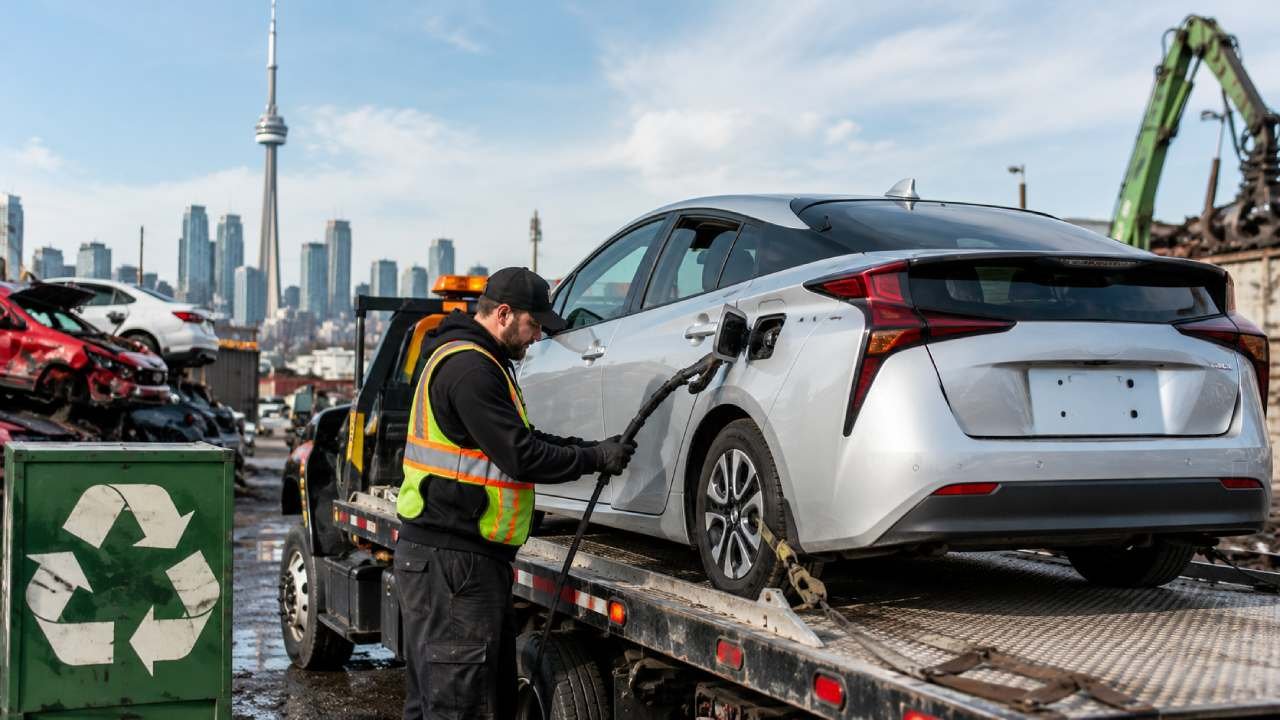
A licensed tow truck arrives at your home, driveway, or parking spot at the scheduled time. Your car does not need to start or move under its own power.
You receive payment the moment the vehicle is loaded, typically by cash or e-transfer. A reputable scrap car removal service completes this step with zero hidden deductions or delays.
Toronto residents with a damaged EV can also explore options for accident damaged vehicles if an insurer declared the car a total loss.
Step 5 – Cancel Your Registration
After pickup, notify ServiceOntario to close your vehicle record and return your license plates. This step protects you from future insurance or licensing charges tied to a car you no longer own.
Never attempt to remove the EV battery yourself at any point in this process. Even a fully drained pack retains dangerous voltage, and only certified staff carry the correct protective equipment.
What Is Your Scrap Electric or Hybrid Car Worth in Toronto?
A scrap electric or hybrid car in Toronto typically earns between $500 and $2,000 in 2026. Battery condition, vehicle weight, and current metal prices all move this figure up or down.
Scrap Value by EV and Hybrid Model
Different models carry different scrap values because of battery chemistry and body materials. Named examples include the Tesla Model 3, Nissan Leaf, Toyota Prius, Hyundai Ioniq 5, and Chevrolet Bolt.
| EV/Hybrid Model | Battery Type | Approx. Scrap Value (Ontario) |
| Tesla Model 3 | Lithium-ion NCA | $800-$2,000+ |
| Nissan Leaf | Lithium-ion LMO | $600-$1,400 |
| Toyota Prius (Hybrid) | NiMH | $500-$1,100 |
| Hyundai Ioniq 5 | Lithium-ion NMC | $900-$2,000+ |
| Chevrolet Bolt | Lithium-ion NMC | $700-$1,600 |
A Tesla Model 3 typically earns $800 to $2,000 or more because of its aluminum-heavy body and reusable motor components. A Toyota Prius hybrid, by comparison, typically earns $500 to $1,100 due to its smaller NiMH pack.
Factors That Increase Your Payout
Five factors determine your final offer: vehicle weight, battery condition, make and model, current steel and copper prices, and demand for reusable parts such as motors, sensors, and display screens.
Steel in Ontario currently trades around $180 CAD per net tonne (0.9 metric tonnes), while copper trades above $5 CAD per pound (0.45 kg). A heavier vehicle with more recoverable copper wiring earns a higher offer from most yards.
Free towing adds further value to your payout, since arranging this service separately typically costs $100 to $300. Ask for a get a cash quote conversation that includes towing before you accept any offer.
Demand for reusable parts changes month to month, so 2 quotes from different recyclers can vary by hundreds of dollars. Compare at least 2 offers before you schedule pickup, and confirm each quote includes towing.
How Does EV Battery Recycling Work in Toronto?
EV battery recycling in Toronto follows a strict 4-step sequence set by Ontario’s Resource Recovery and Circular Economy Act. Only CAREC-certified facilities may perform this work legally.
Battery Removal and Fluid Draining
A trained technician extracts the high-voltage pack first, using insulated tools rated for 400 volts or higher. Coolant, brake fluid, and battery electrolyte get drained and disposed of under Ontario environmental rules next.
Component Recovery and Metal Recycling
Functional parts such as motors, sensors, and display screens get salvaged for resale after the fluids are removed. The remaining frame then gets shredded, with steel, aluminum, and copper separated for reuse in manufacturing.
Lithium, cobalt, and nickel inside the battery cells get recovered through a specialized process rather than sent to a landfill. This recovery step protects the environment and supports your vehicle’s resale value at the same time.
What Happens to Your Insurance When You Scrap an EV in Toronto?
Your insurance policy does not cancel automatically the moment you scrap your electric or hybrid car. You must contact your insurer directly to end coverage on that vehicle.
Call your insurance provider within 24 hours of pickup and provide the bill of sale from your recycler. Most insurers issue a partial refund for any prepaid premium once you confirm the cancellation date.
If your insurer already declared the vehicle a total loss after an accident, the payout timeline runs separately from your scrap transaction. Keep both settlement documents, since ServiceOntario may request either one during deregistration.
Comprehensive coverage on an EV or hybrid often costs more than coverage on a comparable gas car, due to the higher battery replacement cost. Cancelling promptly after scrapping stops these premium payments from continuing unnecessarily.
When Should You Scrap Your Electric or Hybrid Car?
You should scrap your electric or hybrid car once repair costs exceed its resale value or your insurer declares it a total loss. Waiting past this point rarely improves your final payout.
Signs Your EV Needs Scrapping
Watch for 3 clear signs: your battery range has dropped below 50 km (31 miles), a replacement battery quote exceeds $12,000, or your insurer has issued a total-loss declaration.
A degraded battery pack still holds meaningful scrap value through its lithium, nickel, and cobalt content. Selling now often nets more cash than continuing to drive a range-limited vehicle.
Signs Your Hybrid Needs Scrapping
A hybrid typically needs scrapping once the battery replacement quote reaches $3,000 or more. Repeated dashboard warning lights tied to the hybrid system signal the same outcome.
High mileage beyond 240,000 km (150,000 miles) combined with a failing hybrid battery makes repair costs difficult to justify. Scrapping at this stage protects you from a second major repair bill.
Electric and Hybrid Cars vs Gas Cars: Key Scrapping Differences
Electric and hybrid cars require certified staff, specialized tools, and stricter documentation than gas cars. The comparison below outlines the 8 main differences between the 2 vehicle categories.
| Factor | Gas-Powered Car | Electric / Hybrid Car |
| Battery type | 12-volt standard battery | High-voltage lithium-ion or NiMH pack |
| Certified staff required | No | Yes, CAREC-certified only |
| Scrap value range (Ontario) | $200-$800 | $500-$2,000+ |
| Documents needed | Ownership + ID | Ownership + ID + plate return |
| Free towing included | Yes, most providers | Yes, most providers |
| Fluid removal complexity | Low | High, includes battery electrolyte |
| Metal recovery | Mostly steel | Steel + aluminum + copper + rare metals |
| Processing time | 30-60 minutes | 60-120 minutes |
Quick Reference: Electric and Hybrid Car Scrapping Tasks
Use the table below as a fast checklist before your pickup day arrives. Each task lists its typical timing, method, and difficulty level.
| Task | Timing | Method | Difficulty |
| Get a free quote | 5-10 minutes | Phone or online form | Easy |
| Gather ownership and ID | Same day | Locate green card and photo ID | Easy |
| Schedule pickup | Same day to 48 hours | Call licensed recycler | Easy |
| Battery removal | 30-60 minutes on-site | Certified technician only | Difficult |
| Fluid draining | 20-30 minutes | Certified technician only | Difficult |
| Metal and component recycling | 1-3 days at facility | Shredding and sorting | Moderate |
| Cancel registration | Same day as pickup | ServiceOntario online or in-person | Easy |
| Confirm final payment | At pickup | Cash or e-transfer | Easy |
Frequently Asked Questions About Scrapping Electric and Hybrid Cars in Toronto
Do junk car buyers take electric vehicles in Toronto?
Yes, licensed junk car buyers in Toronto take electric vehicles. Confirm the buyer holds CAREC certification for high-voltage battery handling before booking your pickup.
Can you sell a used Tesla for scrap in Toronto?
Yes, you can sell a used Tesla for scrap in Toronto through any CAREC-certified recycler. A Tesla Model 3 or Model S often earns a higher offer due to its aluminum-heavy construction and reusable motor components.
Do you need to remove the EV battery before pickup?
No, you do not need to remove the EV battery before pickup. A licensed recycler brings trained staff and insulated equipment to remove the battery safely on-site.
Does your EV need to be running to get scrapped?
No, your EV does not need to be running to get scrapped. A licensed scrap car removal service tows vehicles with dead batteries, flat tires, or accident damage regardless of condition.
What Ontario regulations apply to scrapping an electric vehicle?
The Resource Recovery and Circular Economy Act governs EV battery disposal in Ontario. Only CAREC-certified facilities may legally process electric and hybrid vehicles, from battery extraction through final metal recovery.
How long does it take to scrap an electric or hybrid car in Toronto?
Most full scrapping appointments in Toronto take between 60 and 120 minutes from arrival to payment. Battery removal and fluid draining account for most of that added time compared to a gas car.
Get Cash for Your Electric or Hybrid Car in Toronto Today
Toronto’s licensed scrap car buyers handle electric and hybrid vehicles with certified staff, specialized tools, and full regulatory compliance in 2026. Whether you own a Tesla, a Prius, or a Nissan Leaf, a certified recycler manages the battery, the paperwork, and the payout for you.
Comparing 2 or more quotes, confirming CAREC certification, and cancelling your insurance promptly all protect your final payout. These 3 habits turn a stressful process into a same-day cash transaction.
Ready to turn your electric or hybrid vehicle into cash today? Contact Scrap Cars 4 Cash and get a cash quote for same-day pickup across the GTA.