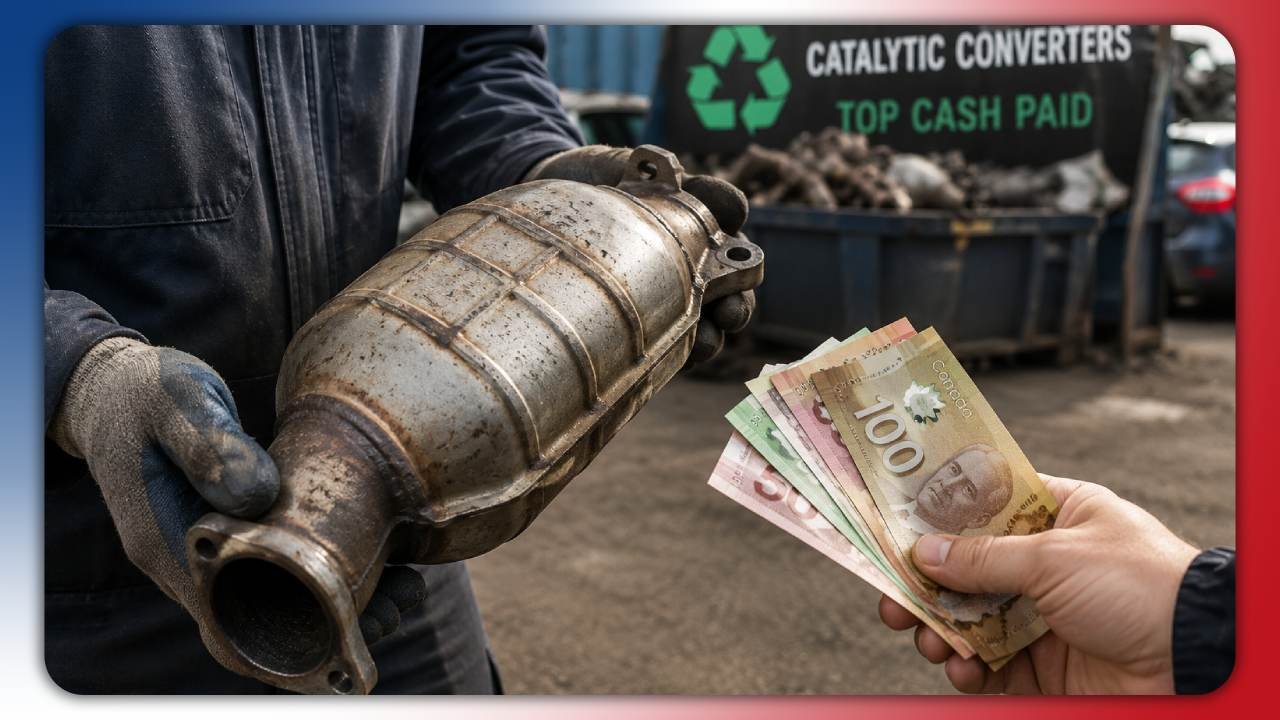
You sell your catalytic converter for cash in Ontario by taking it to a licensed scrap buyer who pays based on live metal prices. Payouts in 2026 range from $40 for a small aftermarket unit to $900 or more for a hybrid converter from a Toyota Prius. Your exact payout depends on 3 factors: the precious metals inside the unit, your vehicle type, and the converter’s physical condition.
This guide ranks the 5 best places to sell a catalytic converter for cash in Ontario in 2026. You will also learn how to check your converter’s value, confirm Ontario’s legal requirements, and decide whether selling the converter alone beats scrapping the entire vehicle.
How Much Is Your Catalytic Converter Worth in 2026?
Your catalytic converter is worth $40 to $900 or more in 2026, depending on 3 factors: platinum group metal (PGM) content, vehicle type, and physical condition. Platinum, palladium, and rhodium sit inside a ceramic honeycomb substrate roughly 6 inches (15 cm) long, and these 3 metals set almost all of the converter’s scrap value.
Rhodium currently commands the highest price per gram of the 3 PGMs, so a converter with a higher rhodium load pays more even at the same physical size. An original equipment manufacturer (OEM) converter typically holds far more PGM than a generic aftermarket replacement, which is why OEM units from brands like Toyota, Honda, and BMW consistently outsell aftermarket units at Ontario scrap buyers.
Condition matters just as much as metal content. A cracked, crushed, or hollowed converter loses its ceramic substrate, and that loss can drop the unit’s value to near zero overnight. Store a removed converter flat, in a dry spot, and away from hard impacts until you are ready to sell.
Where to Sell a Catalytic Converter for Cash in Ontario: 5 Options Ranked
You have 5 main options when you sell a catalytic converter for cash in Ontario, and the payout gap between the best and worst option can exceed $300 on a single unit. Here are the 5 options, ranked from highest to lowest payout.
Licensed Scrap Car Buyers Pay the Most
Licensed scrap buyers pay the most because they quote against live PGM spot rates and cut out the middleman entirely. These buyers handle high volumes of converters each month, which lets them offer sharper prices than smaller operators can manage. If you are also retiring the vehicle itself, a full scrap car removal service often factors your converter’s value directly into a single combined cash offer, which usually beats a standalone converter sale.
Auto Salvage Yards Offer a Fast Backup Option
Salvage yards buy converters too, but they typically pay 20% to 30% below licensed scrap buyers. Most salvage yards lack precision assay equipment, so their quotes stay conservative by design rather than by malice. Choose this option when you need same-day cash and a licensed buyer is not available nearby.
Private Marketplace Sales Carry Legal Risk
Private platforms like Kijiji and Facebook Marketplace host converter listings, but these sales carry 3 real risks: unverified buyers, unregulated transactions, and personal liability if the buyer cannot prove lawful handling. A licensed buyer removes all 3 risks at once and typically matches or beats private-sale pricing anyway.
Online price-comparison platforms such as iScrap App let you check regional rates before you commit anywhere in person, though you still need a physical buyer to complete the sale. Retail auto parts counters pay the least, often 50% to 60% of market value, because they resell your unit into the scrap market themselves and keep the difference as profit.
How to Check Your Catalytic Converter’s Value Before You Sell
To check your catalytic converter’s value before you sell, confirm 2 things: your exact serial number and the current PGM spot prices. Both steps take under 10 minutes combined and can add $100 to $200 to your final payout.
How to Find and Read Your Serial Number
To find and read your serial number, locate the stamped code on the converter body, usually near the welded seam. Clean the area with a wire brush and soapy water until the digits are legible, then note the full code exactly as it appears. Buyers use this number to identify your exact converter model and its associated metal load, so a clear reading leads directly to a more accurate quote.
How to Check Live Platinum, Palladium, and Rhodium Prices
To check live platinum, palladium, and rhodium prices, visit a metals-tracking site such as RRCATS or AutoCatalystMarket before you call any buyer. Prices shift daily, and a sudden spike in rhodium alone can add hundreds of dollars to your payout within a single week. Compare at least 3 quotes from different buyers on the same day, since the spread on a single converter can exceed $150.
Which Vehicles Have the Most Valuable Catalytic Converters in 2026?
Hybrid vehicles carry the most valuable catalytic converters in 2026 because their gasoline engines run less often, so the converter faces less thermal stress over its lifetime. The Toyota Prius leads this category, with Gen 2 through Gen 4 models paying $350 to $900 depending on the exact production year.
European performance brands rank second. Vehicles like the Porsche Cayenne V8, BMW 5 Series, and Audi A6 use heavier PGM loading to meet both European and North American emissions standards at once, so their converters pay $200 to $1,200 depending on the model.
Standard Japanese OEM converters, including those from the Honda Civic, Toyota Camry, and Nissan Altima, form the largest trading volume at Ontario buyers and pay $80 to $280 depending on engine size. Full-size trucks such as the Ford F-150 and RAM 1500 run dual converter systems, and selling both units together in a single transaction raises your total payout meaningfully compared with selling one unit alone.
Diesel Converters Pay Less Than Gasoline Converters
Diesel catalytic converters, known as diesel oxidation catalysts (DOC), typically pay $40 to $150 in Ontario because they use only 2 of the 3 platinum group metals: platinum and palladium. Gasoline converters use all 3 metals, including rhodium, and rhodium alone can represent 40% to 60% of a gasoline converter’s total scrap value. Diesel particulate filters (DPF) on larger trucks, including the Ford F-250 and RAM 2500, hold meaningful platinum content and often pay $100 to $400 on their own, so present the DOC and DPF as separate units for the most accurate combined quote.
Is It Legal to Sell a Catalytic Converter for Cash in Ontario?
Yes, selling your own catalytic converter for cash in Ontario is fully legal when you follow the correct process. Ontario’s Scrap Metal Dealers and Recyclers Act requires every licensed buyer to record your full name, address, valid government-issued photo ID, and proof of vehicle ownership before completing any purchase.
Never sell to a buyer who skips the ID check or waives the ownership verification step. That behavior signals the buyer may operate outside Ontario’s legal framework, and it creates direct liability for you even when the converter genuinely came from your own vehicle. Keep a copy of the transaction receipt, particularly if you plan to sell parts more than once.
How to Avoid Catalytic Converter Scams in Ontario
To avoid catalytic converter scams in Ontario, watch for 3 warning signs: cash-only deals with no paperwork, quotes far below the current spot-price range, and buyers who refuse to weigh or inspect the unit before naming a price. Legitimate buyers welcome documentation because Ontario law requires it, so hesitation on this point is a direct red flag.
Confirm a buyer’s license status before you travel to their location, and bring a second person with you when you complete a cash transaction for extra security. Report any buyer who pressures you to skip ID checks to local police, since that pattern matches known converter-theft resale schemes across the GTA.
Photograph your converter’s serial number before you hand it over, and request a written or emailed receipt that lists the amount paid, the date, and the buyer’s business name. This simple record protects you if a dispute arises later, and it gives you a reference point the next time you compare quotes on a different vehicle.
How to Sell Your Catalytic Converter for Cash in 4 Steps
To sell your catalytic converter for cash, follow 4 steps: locate your serial number, collect 3 quotes, confirm your documents, and complete the sale with a licensed buyer.
- Locate and clean your serial number so buyers can quote with precision.
- Call at least 3 licensed buyers and compare offers on the same day.
- Gather your government-issued photo ID and vehicle ownership documents.
- Hand over the converter to your chosen buyer and collect payment on the spot.
The table below breaks each step down by timing, method, and difficulty.
| Task | Timing | Method | Difficulty |
| Locate serial number | 5-10 minutes | Wire brush and soapy water | Easy |
| Check PGM spot prices | 5 minutes | RRCATS or AutoCatalystMarket | Easy |
| Collect 3 quotes | 15-30 minutes | Phone calls to licensed buyers | Easy |
| Gather ID and ownership | 10 minutes | Locate documents at home | Easy |
| Complete the sale | 15-20 minutes | In-person drop-off or pickup | Moderate |
Should You Sell Your Converter Alone or Scrap the Whole Vehicle?
Scrap the whole vehicle when the car itself has reached the end of its useful life, since a combined offer usually beats selling the converter alone. Licensed buyers add your converter’s value directly into a full cash for cars offer, alongside the weight of the remaining steel, aluminum, and copper in the vehicle.
Sell the converter alone when your vehicle still runs and only needs a replacement part swapped in, such as after a theft or a failed emissions test. Residents in cities like Brampton, Burlington, and Mississauga can use the same licensed-buyer process either way, since Ontario’s documentation rules apply equally to standalone converter sales and full vehicle scraps. A Brampton scrap car service, for example, will assess your converter and your vehicle in the same visit, so you only need one appointment.
Compare both paths before you decide. Request a standalone converter quote and a full vehicle quote from the same licensed buyer, then subtract your converter’s individual quote from the combined offer. If the combined number is higher, scrapping the whole vehicle puts more cash in your hand for the same amount of effort.
If you have been searching for where to sell your catalytic converter for cash in Ontario, the answer comes down to 2 things: choose a licensed buyer, and check your converter’s value before you commit to any offer. Confirming your serial number and comparing 3 quotes can add $100 to $200 to your final payout with almost no extra effort. For a free, no-obligation quote on your catalytic converter or your entire vehicle, contact Scrap Cars 4 Cash today and get paid the same day you call.
Frequently Asked Questions About Selling a Catalytic Converter in Ontario
Is it legal to sell a catalytic converter in Ontario?
Yes. Selling your own catalytic converter in Ontario is legal when you provide valid photo ID and proof of vehicle ownership to a licensed buyer.
Can I sell just the catalytic converter without scrapping the whole car?
Yes. You can sell a standalone catalytic converter with valid ID and proof that the converter came from a vehicle registered in your name.
How much is a catalytic converter worth in Ontario in 2026?
Most standard converters sell for $80 to $400, while hybrid units like the Toyota Prius reach $900 or more when rhodium prices climb.
Do I need my vehicle ownership papers to sell a catalytic converter?
Yes. Ontario’s Scrap Metal Dealers and Recyclers Act requires proof of ownership for every converter transaction.
Which pays more, a licensed scrap buyer or an auto parts store?
A licensed scrap buyer pays more, often 30% to 50% above what an auto parts store offers for the same unit.