You donate a junk car for charity in Canada by contacting a licensed vehicle donation program, scheduling free towing, and signing your ownership over to your chosen charity. The charity’s towing partner picks up your car within 24 to 48 hours and mails you a tax receipt for the sale value within 2 to 4 weeks.
Thousands of Ontario residents donate old vehicles every year instead of selling them for cash. You support causes like Habitat for Humanity, Canadian Red Cross, Diabetes Canada, and BC SPCA while clearing space in your driveway. This guide covers the exact 5 steps to donate a junk car for charity, the tax receipt rules set by the Canada Revenue Agency (CRA), and the real dollar difference between donating your car and selling it for scrap in 2026.
Donating a vehicle differs from a private sale in 3 key ways: you skip buyer negotiations, you receive a tax document instead of cash, and a licensed partner handles every piece of paperwork. This guide walks you through eligibility, the 5-step process, tax rules, and the honest comparison against selling for scrap value.
What Does Donating a Junk Car for Charity Mean in Canada?
Donating a junk car for charity means you transfer ownership of an unwanted vehicle to a registered non-profit organization instead of selling it. The charity sells or recycles your car and keeps 100% of the proceeds for its programs. You receive a tax receipt equal to the sale price, which lowers your income tax owing.
Registered charities in Canada work with licensed towing companies and scrap yards to process each donated vehicle. The Automotive Recyclers of Canada (ARC) certifies many of these recycling partners under a strict environmental code. Your car never needs to run, start, or pass an inspection to qualify for donation.
Charities partner with third-party processors for 3 main reasons: they lack their own tow trucks, they need certified recyclers for safe disposal, and they need a licensed dealer to handle resale paperwork. This partnership model means your donation experience looks similar no matter which charity you choose.
Is Your Vehicle Eligible to Donate for Charity in Canada?
Your vehicle qualifies for charity donation if you hold the ownership permit and the car sits on private property or a legal parking spot. Charities accept cars, trucks, vans, motorcycles, and RVs in any mechanical condition. A vehicle with a rebuilt or salvage brand on its title still qualifies for most donation programs.
Vehicles with 3 common issues still qualify without penalty: a dead battery, a blown engine, or flood damage. Abandoned vehicles on public streets do not qualify until you register proper ownership first. Leased vehicles do not qualify because the leasing company, not you, holds legal title.
Vehicle age never disqualifies a donation. A 1998 Honda Civic and a 2022 Toyota Corolla both qualify under the same rules, though newer vehicles typically generate a larger tax receipt. Missing parts such as a windshield, bumper, or interior seats do not block eligibility either, since recyclers process incomplete vehicles every day. Confirm your specific make and model with the charity’s intake team if your vehicle has an unusual modification, such as a rebuilt frame or a swapped engine.
How to Donate a Junk Car for Charity in 5 Steps
To donate a junk car for charity, you complete 5 steps: pick a charity, request a pickup, sign the ownership transfer, hand over your keys, and collect your tax receipt. Each step takes less time than selling your car privately.
Step 1: Choose a Registered Canadian Charity
To choose a registered charity, search the CRA’s public charity list or call your preferred organization directly. Confirm the charity accepts vehicle donations before you request a tow truck. Popular categories include children’s hospitals, animal shelters, and disaster relief funds.
Step 2: Book Free Towing and Pickup
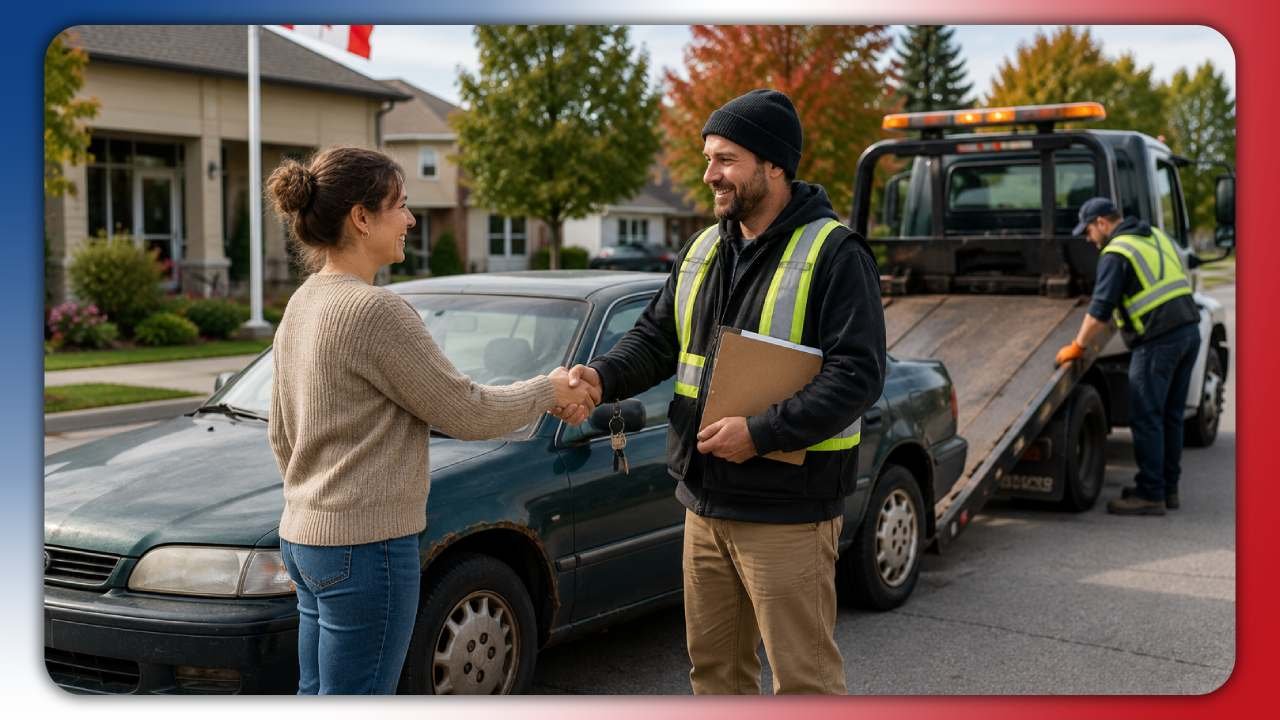
To book free towing, call the charity’s donation hotline or fill out its online form with your car’s year, make, and model. Most programs schedule pickup within 24 to 48 hours across Ontario cities such as Toronto, Mississauga, and Brampton. You do not pay any towing fee at any point in the process.
Step 3: Sign the Ownership Transfer Documents
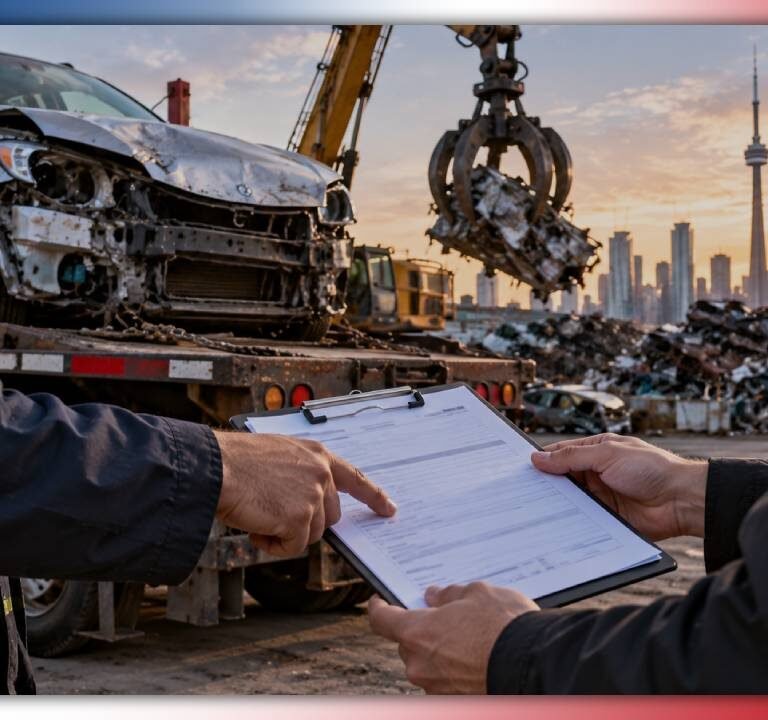
To sign the ownership transfer, you complete the vehicle transfer portion of your Ontario Ministry of Transportation (MTO) permit and hand it to the tow driver. The driver also collects your license plate unless you plan to transfer it to another car. Keep a copy of the signed transfer for your own records.
You then remove personal items from the vehicle and hand over both sets of keys. The charity’s partner completes the pickup and confirms the transaction with a signed release form. Your tax receipt arrives by mail or email within 2 to 4 weeks. Set a reminder on your calendar for 4 weeks out so you can follow up if the receipt has not yet arrived.
Which Charities Accept Junk Car Donations in Ontario?
Most national and regional charities in Ontario accept junk car donations, including children’s hospitals, cancer research foundations, and animal welfare groups. Habitat for Humanity, the Canadian Red Cross, Diabetes Canada, and BC SPCA all run active vehicle donation programs. You choose the organization when you donate a junk car for charity through most pickup services.
Local charities such as food banks, shelters, and community health centers also accept vehicle donations through regional pickup partners. Call ahead to confirm your specific charity works with a towing service in your city. Some smaller charities redirect vehicle donations through a national partner network instead of handling pickup themselves.
Charities generally fall into 4 categories that accept vehicle donations: medical research groups, youth and family services, animal welfare organizations, and disaster relief agencies. Each category uses your car’s proceeds differently, so ask the charity directly how it allocates vehicle donation revenue. A children’s hospital foundation typically directs funds toward equipment and patient care programs.
How Much Tax Credit Do You Get for Donating a Junk Car?
You get a tax credit equal to the amount your donated car sells for at auction or recycling, not its estimated market value. Canadian tax law allows you to claim this amount as a charitable donation on your annual income tax return. The federal charitable tax credit rate reaches 33% on donations above $200 for taxpayers in the highest income bracket.
How the Canada Revenue Agency Values Your Receipt
The Canada Revenue Agency (CRA) requires charities to issue a receipt based on the actual sale proceeds of your vehicle, confirmed after the sale closes. A car worth $500 in scrap value generates a $500 receipt, not a receipt based on its original purchase price. You claim this credit using your Notice of Assessment from the CRA the following tax season.
A sample calculation shows the real impact: a $600 vehicle donation at the 33% federal rate returns roughly $198 in combined federal and provincial tax savings. Add your provincial charitable credit rate, which varies by province, for a more precise total. Ontario residents typically see a combined federal and provincial credit rate between 40% and 46% on donations above $200.
Keep your original receipt for 6 years, since the CRA can request supporting documents for that period after you file. File your receipt with your tax return using the charitable donations line on your federal return, then carry forward any unused amount for up to 5 years if you do not need the full credit this tax season. Couples filing jointly should combine donation receipts under 1 spouse’s return to reach the higher-rate threshold faster.
Donate Junk Car Charity vs Sell for Cash: Which Pays More?
Selling your junk car for cash pays more money upfront than donating it, but donating gives you a tax credit instead of instant payment. A car worth $400 in cash produces roughly $130 to $150 back through a federal tax credit if you donate it instead. You keep the full $400 if you sell it directly to a scrap buyer.
Choose donation if supporting a specific cause matters more to you than maximizing your payout. Choose a cash sale if you need immediate funds or your vehicle holds high scrap value. Vehicles with valuable catalytic converters, aluminum wheels, or working engines often sell for more cash than their donation tax credit would return.
Consider 3 factors before deciding between donation and a cash sale: your current need for immediate funds, your marginal tax rate, and how strongly you feel about a specific charity’s mission. Owners in a high tax bracket often recover a larger share of their car’s value through donation than owners in a lower bracket. If you decide selling makes more financial sense, a licensed scrap buyer can complete a same-day cash for cars option with free towing included, matching the convenience of a charity pickup.
What Happens to Your Junk Car After Donation?
Once you donate a junk car for charity, your vehicle goes to a certified recycling facility, an auto auction, or a licensed dismantler depending on its condition. Charities typically sell running vehicles at auction and send non-running vehicles directly to recyclers. Neither process leaves your car sitting unused on charity property.
The 98% Vehicle Recycling Recovery Rate
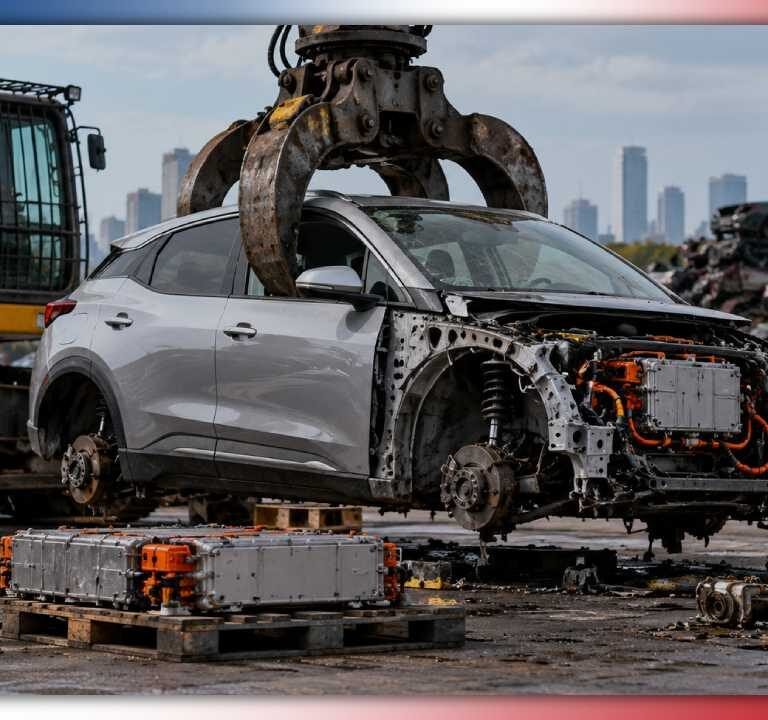
Certified recyclers recover 98% of every vehicle’s materials, including steel, aluminum, glass, and rubber. A single recycled car provides enough steel to help manufacture new vehicles, appliances, and construction materials. Technicians drain and safely dispose of fluids such as oil, coolant, and transmission fluid before the crushing stage begins.
Ontario recyclers follow the End-of-Life Vehicle (ELV) environmental standard enforced by the Ministry of the Environment. This standard requires proper handling of mercury switches, refrigerants, and lead-acid batteries. A responsible junk car pickup and donation program confirms its recycling partners hold this certification before accepting your vehicle.
Recycling a single vehicle also saves roughly 2,500 pounds (1,134 kg) of iron ore, 1,400 pounds (635 kg) of coal, and 120 pounds (54 kg) of limestone from new mining. These savings come from reusing recovered steel instead of producing new raw steel from scratch. A donated car therefore reduces environmental impact even before the charity receives a single dollar.
Documents You Need to Donate a Junk Car in Canada
Before you donate a junk car for charity, gather 4 documents in advance: your vehicle permit, a signed bill of sale or transfer form, matching photo identification, and your license plate portion if you keep the plate. Missing your vehicle permit delays your donation by several days while you request a replacement from ServiceOntario.
Bring identification that matches the name on your vehicle registration exactly. If a family member’s name appears on the permit instead of yours, that family member must sign the transfer in person or provide notarized consent. Charities cannot accept a vehicle donation without a matching, valid ownership document.
Estates and inherited vehicles require 1 additional document: a copy of the will or a notarized letter from the executor confirming your authority to donate the car. Joint owners on a permit must both sign the transfer unless one owner holds power of attorney for the other. Keep photocopies of every signed document until your tax receipt arrives.
Junk Car Donation Timeline at a Glance
| Task | Timing | Method | Difficulty |
| Choose a charity | 1 day | Phone call or website form | Easy |
| Request pickup quote | Same day | Online form or phone call | Easy |
| Free towing pickup | 24-48 hours | Licensed tow truck | Easy |
| Sign ownership transfer | At pickup | Paper transfer document | Moderate |
| Vehicle recycling or sale | 5-10 days | Certified recycler or auction | N/A |
| Tax receipt delivery | 2-4 weeks | Mail or email | Easy |
Frequently Asked Questions About Donating a Junk Car for Charity
Can you donate a junk car that does not run in Canada?
Yes, charities and their towing partners accept non-running vehicles in any condition, including cars with dead batteries, flat tires, or engine failure.
Do you get a tax receipt for donating a scrap car?
Yes, registered charities issue a tax receipt equal to your vehicle’s confirmed sale proceeds within 2 to 4 weeks of pickup.
Is towing free when you donate a junk car for charity?
Yes, every legitimate vehicle donation program in Canada includes free towing with no hidden fees charged to you.
Can you choose which charity receives your car donation?
Yes, most donation programs let you select your charity from a list or name your own registered organization during the request process.
Is it better to donate a junk car or sell it for cash in 2026?
Selling for cash returns more total money for vehicles with working parts, while donating suits owners who prioritize supporting a cause over maximum payout.
Donating a junk car for charity in Canada takes less than a week from your first phone call to your signed tax receipt. You support a cause you care about, clear your driveway, and avoid every towing fee along the way. If your vehicle’s scrap value matters more to you right now, request a free quote through our scrap car removal service and compare your cash offer before you decide. For non-running vehicles taking up space, our free junk car pickup team can also collect your car the same week, running or not. Contact our cash for cars option today to get an instant quote either way. Whichever route you pick, you finish the process in days, not weeks, and your driveway stays clear for good.